Topology/Connectedness
Motivation
To best describe what is a connected space, we shall describe first what is a disconnected space. A disconnected space is a space that can be separated into two disjoint groups, or more formally:
A space is said to be disconnected iff a pair of disjoint, non-empty open subsets exists, such that .
A space that is not disconnected is said to be a connected space.
Examples
- A closed interval [a,b] is connected. To show this, suppose that it was disconnected. Then there are two nonempty disjoint open sets A and B whose union is [a,b]. Let X be the the set equal to A or B and which contains x. Let s=sup{c|c∉X,c∈[a,b]}. If s is within X, then there is an open set (c-ε,c+ε) within X, implying that s is not an upper bound. If s is not within X, then s is within [a,b]\X, which is also open, and there is an open set (c-ε,c+ε) within [a,b]\X, implying that it is not the supremum.
- The topological space is disconnected:
A picture to illustrate: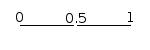
As you can see, the definition of a connected space is quite intuitive; when the space cannot be separated into (at least) two distinct subspaces.

Definition
A subset U of a topological space X is said to be clopen if it is both closed and open.
Theorems about connectedness
Theorem: The image of a connected set under a continuous function is also connected.
Proof: Let X be connected, and let f be a continuous function. Suppose f(X) is disconnected. Then there exists two nonempty disjoint sets A and B whose union is f(X). Then f-1(A) and f-1(A) are nonempty disjoint sets whose union is X, contradicting the fact that X is connected. Thus, f(X) is connected.
Note: this shows that connectedness is a topological property.
Theorem: If two connected sets have a nonempty intersection, then their union is connected.< br /> Proof: Suppose there are two open sets A and B which whose union is the union of X∪Y which are connected and have a nonempty intersection. Let x be in their intersection, and let suppose that x is C, which is either A or B. Let y be an element of Z, which is X or Y. If y is within the other set, then the intersection of the other set with Z and the intersection of C with Z makes two disjoint open nonempty sets who union is Z, contradicting the fact that Z is connected. Thus, y must be within the same set, implying that the other set is empty. Thus, there are no two nonempty open sets A and B which whose union is X∪Y, and so X∪Y is connected.
Exercises
- For any topological space X, the empty set and the entire space are clopen.
- Show that a topological space X is disconnected if and only if it has clopen sets other than and (Hint: Why is clopen?)
- Prove the mean value theorem: if f:R→R is a continuous function for [a,b], then for any y between f(a) and f(b), there exists a c∈[a,b] such that f(c)=y.
- Prove that R is not homeomorphic to R2 (hint: removing a single point from R makes it disconnected).