Testwiki:Reading room/Archive 1
Writing a Textbook
Well, I think this needs some discussion.
I am afraid some might think that writing a textbook is very much similar to writing a larger Wikipedia article or making a Wikipedia project.
In my opinion this is a dangerous misconception. We all, I suppose, have read dozens of textbooks. We can tell the difference between a good textbook and a collection of dead trees.
It is much more than just putting into writing some accurate, factual
information and making it readable.
Writing a good textbook is hard work, I guess (I haven't written any). It takes a brilliant concept, a good design, thoughtful methodology and a good dose of multimedia. A good textbook talks to students, explains, guides them etc
Perhaps before actually writing we should spend some more time on planning,
ideas and design ?
Kpjas 20:58 5 Aug 2003 (UTC)
- We might as well try free-form growth to see if it can produce a decent textbook. After all some people argued that you couldn't write an encyclopedia with free-form growth. --Imran
- I think both are important - just as we are doing now (see textbook planning). Plans will be modified by and evolve with the experience we gain by creating test cases. We do, of course, need a wiki way of assembling and reorganizing books (hard coding navigational aids is not wiki). --mav
- Whether of not hard coding navigational aids is "wiki", its a lot of work and I'd love to be able to automate the process. Karl Wick
- In my opinion good text books (especially for languages) encourage a lot of dialogs/cooperation between students. So an idea would be to enrich the textbook exercises with tables where people can place/respond to requests for study partners (for example setting up times for an irc/icq chat in a foreign language). I would like to hear your opinions on that. Thanks. Thomas
- I think it is a good idea especially for online version of (language) textbooks. The problem is how to persuade not to fall back to English at some point ;-) Kpjas
- Hm. Sounds like that would be a good thing to have in a subdomain; the Wikibooks Classroom at http://classroom.wikibooks.org (different languages would have different translations of the word "classroom". We could also create tools for instructors to use to make lesson plans, activities and, of course, have dialogs with their students (and student to student interaction). But here, IMO, we should concentrate on textbook and related material development. Just thinking out loud - all that will require some pretty serious software that we simply don't have yet. Still an interesting thing to keep in mind for future planning. --mav 07:59 6 Aug 2003 (UTC)
- What if we set up a mailing list, maybe Wikimediateacher-l or something like that, where people looking for teachers for to go along with wikibooks material or just plain old wikipedia could find a teacher, also a member of the list. Once your teacher is found or you are sufficiently paired up with a student, you start an email and IM correspondance and quit the list, unless you want more teachers or students. The whole thing could be completely pseudonomous, just like the rest of Wikimedia, unless the individual users want to divulge their real name. LittleDan 17:08 7 Aug 2003 (UTC)
- I like the idea of having a specialized Wiki classroom project (maybe WikiCourses?) with its own subdomain. Before I heard of Wikipedia's textbook project I was actually searching the internet for Wiki sites that are doing this kind of project (but pretty much all of the 'e-learning' sites where forums about e-learning and not actually offering courses). It seems to me that once the Wikibook project is matured a little more (which shouldn't take too long hopefully ;) we can start off the Wiki course/classroom project with its own subdomain and administration & collaboration tools. Thomas
Obstacles to growth
In comparison to Wikipedia, Wikibooks is less inviting to editors because it is harder to approach in a piecemeal fashion. This dooms Wikibooks. If on Wikipedia I start an article called Jimbo Wales and write simply "Jimbo Wales is the founder of Wikipedia", what I created may be a stub, but it is nonetheless a useful and informative encyclopedia article. In the most casual way, I thus have the satisfaction of contributing to the Wikipedia. Unless Wikibooks can find a way to be similarly inviting, friendly and satisfying, I am unable to envision success for it. I see it as imperative to the success of Wikibooks that some prominent, friendly, and intuitive way be devised to encourage the creation of useful stubs. Currently this does not exist. As others have suggested, some method needs to be devised to encourage a proliferation of mass chaos that can be gradually ordered. Here are some seeds for thought: Kupord Maizzed 21:50, 9 Aug 2004 (UTC)
- Encourage contribution of isolated how-tos, recipes, instructions, and equations as independent pages. Have as a goal the enabling of 20-minute stub creation by anonymous visitors. Kupord Maizzed 21:50, 9 Aug 2004 (UTC)
- Provide a prominent link to a categories page so contributors of new material can at least link it by category to a textbook it might someday belong in. Kupord Maizzed 21:50, 9 Aug 2004 (UTC)
Public domain books
OK, I'm up with insomnia right now thinking about all things Wikibook. Since our focus is to create the world's best resource for educational material I believe we should import as many literary classics that are in the public domain as possible. In addition to benefiting from the TOC/modularization concept talked about on the mailing list, we can wikify these old texts using en: interwiki links to encyclopedia articles and we could devise an annotation markup such as <note> ... </note>.
Here is how it would work; In the Origin of Species by Darwin we can have his wikified text on the left 2/3rds of the the wikitext area of a module and the annotation on the right third of the module. That annotation will be placed according to where the <note> ... </note> pair is placed; so if it is placed after heading 3 then that is where the annotation starts.
We could also do this with modules but that would be more complicated (but may be worth it ; that way the annotation could be different for different contexts). I do not think that a public domain resource like that would be viable on its own (such as the long proposed but never enacted m:ProjectSourceburg). Furthermore the WikiQuote community did not like the idea of expanding their focus to cover public domain books (they reluctantly agreed to host speeches, though - but we can have those here too). Also, the annotation function will also be useful in textbooks - print textbooks very often have a narrow column for images and notes.
What say you? Aside: Wikimedia is probably going to have to start a fiction wiki soon (something I am calling "wiktion") so that people can create their own books of fiction. But that would not prevent us from having wikified and annotated public domain fiction here - so long as it has an educational purpose, then that would be fine (such as The Scarlet Letter). I'm really excited about all this! --mav 09:38 29 Jul 2003 (UTC)
- I don't think wikibook should include public domain texts, as I think the gains would be outweighed by the disadvantanges, especially as many other projects already exist which do that kind of thing. Annotated texts however are a different matter all together, and I think they would prove useful, especially as we could annotate many books for which annotated versions are not otherwise commercially viable.
- I think a good example of what we could do is what the site http://www.pepysdiary.com/ is doing for Samuel Pepys' diary. --Imran 15:48 29 Jul 2003 (UTC)~
- Making annotation easy is the whole point and, IMO, simply having the books Wikified (pointing to Wikipedia articles) makes them much, much more useful and fun to read than 'just another website with plain text Chaucer.' If we want to be a full educational resource then we need to have the many of these books - they will get more and more annotated through time. --mav
- I think that wiktion could go right in wikibooks: it's a book, isn't it? And where do we draw the line on annotated fiction works? Just put all the books here. LittleDan 15:21 1 Aug 2003 (UTC)
- PS. Wiktion sounds too much like Wiktionary.
- No. Absolutely not. We should not be in the business of creating our own fictional worlds. We are here to create educational resources for the student not to make things up! Having fiction, as you suggest, is incompatible with that goal - just because Wiktion would use some of the same software features doesn't mean the projects should be in the same wiki. At the very least the fiction section should be in a sub-domain (if you don't like my name choice and cannot think of something different). But the type of community culture in a educational-oriented project, like Wikibooks, and a project aimed at creating its own fictional realms, like Wiktion, are too different to exist side-by-side. --mav 17:34 1 Aug 2003 (UTC)
Guitar textbook?
Is there any interest in a textbook on guitar playing? I'd need some help, as my focus would be mainly on death metal; and I have a limited knowledge of music theory, but I can definitely do the basics like forming chords, basic scales, holding the pick &c. -- Jimregan 02:25, 10 Aug 2003 (UTC)
- IMHO a textbook on playing guitar would "totally rock" !! Just start it and other guitar fans will get on there and add what they know. ( I always wanted to learn guitar). --Karl Wick
- I won't have time to get started until Tuesday evening; I forgot to add that, as a death metal guitarist, most of the stuff I would write would go over most guitarists heads; I haven't always listened to death metal though, I can probably do basic stuff about fingerpicking, as well as tapping, arpeggio shredding &c. -- Jimregan 02:36, 10 Aug 2003 (UTC)
- Is video an OK thing to have? I can probably arrange a digital camera, and can easily do audio examples, but would (short) video clips be too much? And if not, what format, MPEG? -- Jimregan 02:39, 10 Aug 2003 (UTC)
- MPEG-1 is the closest thing to a standard that everyone can play. Quality can leave something to be desired, though... I'm not sure of the patent situation.
- Note that we currently limit uploads to 2 megabytes. --Brion VIBBER 07:29, 11 Aug 2003 (UTC)
- I think MPEG-2 is the only one with a patent problem, maybe MPEG-4, but I've never heard of MPEG-1 patent problems. I don't think the upload limit would be a problem, I'm just talking about short clips (5 seconds max) to demonstrate techniques -- Jimregan 08:06, 11 Aug 2003 (UTC)
- Perhaps use a series of GIFs instead? Or very low FPS animated GIF or something like that? Or would GIF require licensing? Also, where is the link to the textbook? i visited it before, but that was through Recent Changes, and i can't find it now. Search gives me the wikipedia guitar article. -- Kasperl 18:30, 18 April 04
Computer drafting (AutoCAD)
I'd like to do a basic intoruduction to computer drafting using AutoCAD. What is the method for starting a new set of modules? Should I come up with a list of relevant module topics and start editing? - Tobin Richard 07:46, 15 Aug 2003 (UTC)
- Add the name of your book to the Technology section on the Main Page, then use that edit link to create your table of contents. At that point, start creating modules. Welcome aboard! --mav 08:38, 15 Aug 2003 (UTC)
Physics textbook
Ok, guys, I'd like to contribute to the physics book, but I'm not sure exactly what to do. The GFDL book that it links to seems a bit, well, if you don't mind me saying so, weird. I can't imagine most students being able to understand it in the way that book presents it...Maybe it's just me. :) Anyway, should I try to improve on the one there or maybe start another, more 'traditional' style physics book? What do you guys think? Etothex 05:23, 1 Nov 2003 (UTC)
- There is so seldom more than one or two people here at any given time, it is "wierd" to have someone to talk to. Etothex ~ Go over to Talk:German: Lesson 3 for some discussion on that text. As for the Physics text, let me offer the following (I'm no expert on Physics, believe me): Is it possible that what you are calling "wierd" is really just the approach or arrangement of subjects within the text? If so (and I do not know), then your additions could be placed within the existing outline/text in appropriate places and help bridge gaps between approaches. In other words, before starting another text, consider whether the subject matter you would expound on is identical only just arranged more traditionally. If that is the only difference, you could add your stuff where appropriate and perhaps even develop a detailed outline in traditional form that links to the appropriate text pages in the existing "wierd" Physics text. Look over the Botany text. There, I am developing the text as mostly links to appropriate articles at Wikipedia with explanatory discourse where I think it is needed. You could do something similar for a traditional Physics textbook without resorting to writing a parallel text. - Marsh 05:39, 1 Nov 2003 (UTC)
- Yeah, it's the order in which it's presented, like waves first. Then he presents velocity along with Sp. Relativity and acceleration with Gen. Relativity. I can understand sort of why they did that, though...With traditional physics texts, they present classical/newtonian physics first then say oops, newton wasn't quite complete/accurate, now here's relativity and quantum physics to iron that out. The 'radically modern' approach seems best for people taking physics who want to become scientists or engineers. Someone not going into those fields but who wants to take calculus based physics might find the traditional approach easier to understand, I think. I'm interested in seeing what the other guys say, too. Physics is a split subject, anyway. Usually there's a 'Physics for College' textbook, of algebra based physics, and 'Physics for Scientists' of calculus based physics. The 'Radically modern' physics text is calc based, so maybe I can write a algebra bases physics text. That way we're not overlapping. Etothex 05:58, 1 Nov 2003 (UTC)
- You may be right. Two levels of text might be called for - Marsh 08:02, 1 Nov 2003 (UTC)
Multilingual Wikibooks
Hi, I don't read the mail list, so maybe I am repeating something. Is this a multilanguage project like wikipedia? Is possible to start a textbook in another language? I think that it is not contemplated at this moment. For instance: The text book: 'spanish', maybe should be: 'english-español' or 'español from english' or something similar. Well I suppose that you could use the convention 'the word that define the language that you want learn wrote in the language from where your are learning'. I dont know. Wintermute 22:26 6 Aug 2003 (UTC)
- I was wondering about the same thing just a bit ago, surely one of the old-timers will have a good explanation. Karl Wick
- Old timer here. This is the English Wikibooks; although we plan on having textbooks and similar instructional material about different languages (that is, teaching a foreign language to students), the books are written with the intent on teaching English-speaking students. For example, our textbook on Spanish has all its explanatory text in English. We are still a very young project so it will be some time before we are self-aware enough to start setting-up other language versions (NOTE: Wiktionary was set up in December of 2002 and still is not internationalized). --mav
- Oops, I guess I was misunderstanding something here.. So, if some japanese wikipedians want to write a wiki textbook (in japanese), they should go elsewhere, like setting up their own wiki? I might have said something else (misleading), and I would need to make correction. Mav (or anyone else), could you elaborate on this? Thanks. Tomos 00:08, 16 Sep 2003 (UTC)
- That's how it is done on Wikipedia. We may be able to get by with a meta-type internationalization enhanced by language category tags that would change the language of the interface for the user. Therefore visiting a French textbook that has French category tags in it, will change the user's interface to French. That way a developer isn't needed to set up new languages and we can make an international Main Page ourself. This type of internationalization would not be possible for Wikipedia, Wiktionary, or Wikiquote since there would be too many page name conflicts. However, this is a community decision. --mav
- Thanks for the reply. But, yes, I know how things are done within wikimedia sites. I was wondering if I should tell my fellows that they should set up their own wiki, without relying on wikimedia. I mean, like starting their own project independently from wikimedia. Or should I just tell them to contact Jimbo (or the foundation if they are two separate thing) and ask if they can start wikibook projects in Japanese? I got an impression from mav's earlier comments that untill this English project matures, books in other languages will not be supported, or people wanting on those projects are advised to wait and see how things develop here. And I think that was the impression Wintermute got (see below, posted earlier than this one I am posting). I kind of see that there could be a merit to wait and see what is going to happen here (at least I am intending to benefit from observing this project), but I also see the benefits of just letting things happen in multiple languages and expect cross-pollination. I would need to make some correction at Japanese wikipedia if "wait" is the case. And I feel a lot more comfortable if I can be ready to explain why it is perceived a better way. Tomos 20:16, 16 Sep 2003 (UTC)
- I am agreeing with Tomos. I would like to know what exactly the problem with internationalization is. We only need define a good namespace for the pages for avoid problems. In fact there is, at least, one textbook that is not English (I have seen it yesterday in "Languages"). I think that we should set rules for specified the language in the title of the pages. No more is necessary by the moment. In other hand, working only in English could be no very clever. For instance, I am from Spain, I like the project, so I have worked in the Spanish textbook. It seems natural for me work in this textbook because I am a native speaker. But I don't need to learn Spanish. I want to mean that if this project is only for English speakers maybe there are people who are not going to be interested in collaborate. A fork in the project for every different language is not a good idea, at least, is not a good thing for the project itself. Well, that was only my opinion. Regards, and sorry by my English, it’s not very good.Wintermute 15:29, 16 Sep 2003 (UTC)
Wikibooks Logo
Hi mav- well I've decided to hang about here for a bit and see what happens- one thing though is I think this project should have a different logo to wikipedia as it will get confusing remebering exactly which project one is contributing to or viewing, what do you think? Quercusrobur 14:26 3 Aug 2003 (UTC)
- My idea for a logo, have an ex-libris/bookplate style logo with the phrase "ex libris wikimedia". --Imran
- I love it! Nice idea. --mav
- One of the replacement logos for wikipedia has the possibility of having different colors for different sections of wikipedia but the same design. It looks really cool. It's at m:image talk:Ncwiki.png. Specifically, I'm talking about 24 b1. Except ours could be red or something. LittleDan 19:49 4 Aug 2003 (UTC)
Wikipedia Logo contest
One of the logos in the Wikipedia logo contest looks like it would be perfect for us (IMO): http://meta.wikipedia.org/upload/7/7f/Wikipedia3fnlc.jpg It doesn't look like it will win (or even become a finalist). --mav
Logo page
What? Where was the discussion about a logo change? Wikipedia Logo contest is much better concept, IMO. For one thing it has more than one book. --mav 04:24, 25 Sep 2003 (UTC)
- those logos mav suggests for consideration do better convey a sense of a collection of books - Marsh
- Two book logo looking better - Marsh 18:41, 26 Sep 2003 (UTC)
- Here is a page for logo options: Logo discussion. We can submit potential logos there and discuss them. --Karl Wick
Wikibooks Functional Aspects
Annotation markup
You are talking about having more than one column of text on one page, right ? That sounds like a useful feature for my textbook. --Karl Wick 13:39 29 Jul 2003 (UTC)
- Yes. But only one 1/3 slice on the right for notes and smallish images. --mav
Maybe it could be that to make a note on the same line as a particular word, you write in the form (for 'many notes' being next to 'word') "otherwords otherwords word/*many notes*/ otherword otherword", kinda like in some programming languages. For now, we can just use plain old footnotes (linking to article#place works), or you can go for a complicated CSS solution. LittleDan 15:21 1 Aug 2003 (UTC)
- Just use a floating div like we do for images for the occasional markup. Unfortunately this div crosses an hr... See --> --Geoffrey 04:04 3 Aug 2003 (UTC)
Images question
Suppose i want to include an image that's on wikipedia. Should I copy it and upload it to wikibooks or should I just link to it? And how do I link to it anyway?
- Copy it and upload it here. Make sure to also copy over the text on the image page of the Wikipedia image and provide a link to it. --mav
Editable Recent Changes
Is there an equivalent here to en:Wikipedia:Recentchanges? it would be nice to have links to other wikis, and maybe some text to remind us which recent changes we're looking at... -- Merphant 09:51 6 Aug 2003 (UTC)
- Part of an answer may depend on your browser set up. For me, the current URL in the toolbar tells me which Wiki I'm in....LouI
- I think Merphant is talking about interwiki links like Wiktionary:Dog. The answer so far is no. AFAIK each language.php file for each wiki will have to updated with interwiki syntax to our website. This will happen - just not yet (we only recently decided a name for the project and still haven't moved to that URL). --mav
Referencing Wikipedia & Wiktionary
Is there a shortcut way to refernce the Wikipedia or Wictionary? I'm currently using a full reference, such as [http://www.wikipedia.org/wiki/Plant_cell] . This works but its akward. If no current techniaue exists, should we suggest the idea of a simpler or abbrievated markup coding on one of the Meta pages? LouI 05:21, 8 Sep 2003 (UTC)
- EnWikipedia:Dog, w:en:Dog and even en:Dog work (although we may want to reserve the last one for intraproject interlanguage links). Wiktionary only works via Wiktionary:Dog. --mav
I'm going to put the staff lounge back on the main page. As a related question: Do we want to save that name for Wikiversity, and maybe move this page to something like Wikibooks:The stacks? LouI
- Save the name? What do you mean? I already own the domain name... The Wikiversity page is going to be moved to meta soon. --mav
- Sorry, I should have explained more carefully. We now use separate names for the general talk and question space on each project: the pump at wikipedia, the tavern or tea room at wiktionary and the staff lounge at wikibooks. I'd like to suggest that the Staff lounge at wikibooks be renamed. We coiuld make it The Stacks at wikibooks. The reason I suggested this change is that i like the lounge name, but the name seems to fit better with wikiversity. So, if we made the change, we would have The Stacks area in the libary at wikibooks and later (if the prpject takes off) The Staff Lounge, and maybe the Student Lounge at WikiU. I hope thisbetter explains my comment. LouI
- I for one don't know what the stacks means. How about the pub or the coffee house ?
- My apology to Thersa and any others who are puzzled by The Stacks reference. In the U.S. at least, libraries tend to have material freely available (shelved in publicxxly browsable areas) and other material kept in a back room, available only by asking a librarian. Back issue magazines typically get stored in the back room. Since there aren't enough shelves for display, many times the material just gets stacked. When I worked as a library assistant, we called the task of fetching material working the stacks and the stacks were the storage rooms. The idea here, is that the stack room was used only by librarians. LouI
- But we ain't librarians; we are teachers. Thus "staff lounge" is perfect. No reason why Wikiversity can't also have one (Wikiquote also has a village pump). --mav
- Sorry for the first statement, the lounge is still on the main page, just not very visible. LouI 05:28, 8 Sep 2003 (UTC)
Server Issues and Other Wierdness
More problem with logging in
Since two or three days I can't log in anymore. After I type in my username and password I see myself logged in, but as soon as I go to a new page I am logged out again. This is really weird because for example Wikipedia is still working fine for me. Does any one know where this problem may come fron? Thanks Thomas Strohmann
- look further up this page and you'll see the discussion we had about a couple of days ago. Log in to www.wikibooks.org instead of textbook.wikipedia.org. Theresa knott 11:27, 15 Nov 2003 (UTC)
- Thanks Theresa, sorry that I didn't check that earlier. Thomas Strohmann
Wikibooks Namespace Issues
You may have noticed that the Wikibooks namespace is now active and some other changes have taken place. Please discuss additional changes below so that we can finish the localization process:
Known issues:
- The "Bulletin board" link in the sidebar points to a normal module page, not the Wikibooks namespace. A redirect has been created but it would be nice for this link to be direct. --mav 03:44, 11 Aug 2003 (UTC)
- That would require a slight code change, but it could perhaps get done. --Brion VIBBER 07:29, 11 Aug 2003 (UTC)
- The "Bug reports" link in the sidebar correctly points to Wikibooks:Contact us but the displayed link text needs to be changed to "Contact us". --mav 03:44, 11 Aug 2003 (UTC)
- Done. --Brion VIBBER 07:29, 11 Aug 2003 (UTC)
- The logo needs to be changed. --mav 04:42, 11 Aug 2003 (UTC)
- Done. --Brion VIBBER 07:29, 11 Aug 2003 (UTC)
- Need a way to easily edit the text on top of special:recentchanges (wikibooks:recentchanges does not work). Same for Special:Booksources. --mav 04:48, 11 Aug 2003 (UTC)
- Works fine now. --Brion VIBBER 07:29, 11 Aug 2003 (UTC)
- Something strange happened to Wikibooks:TeX markup, Wikibooks:Talk page and maybe others. They have been replaced by their talk pages with no trace. --mav
- Fixed. --Brion VIBBER 07:29, 11 Aug 2003 (UTC)
- It looks like the Calculus page and Welcome to the organic chemistry textbook ! page are missing. -- Karl Wick
- Fixed now.
Other issues/discussion:
TeX wierdness
I think there's some idiosyncracy with TeX markup and the Wiki software here (since I can't get the following problem reproduced at the Wikipedia), but if I create a <math> block which is commented out, an image is created for it, but it does not show, and the next following <math> tag's image is replaced by the previous. This is kinda difficult to explain: If I have
<!-- <math>\lambda^{\lambda^{\lambda}}</math> --> <math>x \sim y</math> <math>x \equiv y</math> , it will render as
- I've noticed that over at Wikipedia, too... Somewhere in Wikipedia:Sandbox's history... Not sure why you couldn't reproduce it, maybe Wikipedia changed since I did it... كсηפ Cyp 15:15, 23 Oct 2003 (UTC)
Multilingualism and Categorization
see #Domains, Modules, Namespaces, Subpages, below.
Domains, Modules, Namespaces, Subpages
The identification of Wikibooks content, via domains & subdomains, modules & namespaces & categories, articles & subpages, is complex. Let's start with the lowest-level identifiers and work our way up.
Domains and transwiki from other projects
On the subject of links, can somebody tell me how to transfer articles from the wikipedia to here? KJ 06:51, 22 Feb 2004 (UTC)
- (Transwiki) To link to the Wikipedia, use [[en:blah]]. To transfer articles, check out Transwiki and m:Transwiki. It's not simple like "move a page", though. HTH Dysprosia 06:59, 22 Feb 2004 (UTC)
- I just read the transwiki stuff and it made my head hurt! I'm not going to try to do it because I don't understand the process at all :( KJ 07:14, 22 Feb 2004 (UTC)
- I think you just copy and paste the stuff between wikis, and just log the fact on the Transwiki page. I think ;) (By the way, on Wikipedia, it seems you are an Aussie too? Where you from?) Dysprosia 07:22, 22 Feb 2004 (UTC)
- I am indeed... I'm in Melbourne and spending my Sunday afternoon trying to figure this thing out :) KJ 08:11, 22 Feb 2004 (UTC)
- I think you just copy and paste the stuff between wikis, and just log the fact on the Transwiki page. I think ;) (By the way, on Wikipedia, it seems you are an Aussie too? Where you from?) Dysprosia 07:22, 22 Feb 2004 (UTC)
- I just read the transwiki stuff and it made my head hurt! I'm not going to try to do it because I don't understand the process at all :( KJ 07:14, 22 Feb 2004 (UTC)
On rereading m:Transwiki, if you want to move a page from the English wp to here:
- copy the text into Notepad
- copy the edit history and the talk into another Notepad window (you can go Page History, select the history manually, copy and paste)
- copy the article text into Transwiki:article name
- copy the edit history text into Talk:Transwiki:article name
- copy the talk after the edit history into Talk:Transwiki:article name
- move Transwiki:article name into the name you want (eg Cookbook:article name).
If this all seems a bit overwhelming, let me know of one article to move over, and I'll show you one procedure by example - how's that? :) (I'm from Sydney btw... oooooo.... ;) Dysprosia 09:11, 22 Feb 2004 (UTC)
- I still don't get it. The moving bit's simple enough, but how do I access the transwiki namespace to find out what's there etc? It seems like the articles will just be going into limbo. KJ 23:42, 22 Feb 2004 (UTC)
- You mean at step 3? All you do is create an article with Transwiki: or Talk:Transwiki: before, and them move them out to the proper name. For example, if you have an article at WP called "Pineapple Recipes", after you've copied the necessary info, create Transwiki:Pineapple Recipes, Talk:Transwiki:Pineapple Recipes, then just move Transwiki:Pineapple Recipes to Cookbook:Pineapple Recipes.
- Afterward you can create a log at the Transwiki page to let them know you've moved the page. HTH Dysprosia
Wikibooks:Subdomains on Wikibooks
In case you hadn't noticed, Wikibooks now has subdomains. I set up redirects from http://wikibooks.org/ and http://www.wikibooks.org/ to Wikibooks portal. --TimStarling
Migrating pages to subdomains:
I wonder if there is the posibility to move a page completely to an other subdomain (including history and discussion). This would be a nice feature. I also do not know if there are legal problems, if we just copy the content.--berni 09:08, 21 Jul 2004 (UTC)
See Wikibooks:Subdomains for more details.
Admins for the sub-domains: New projects get their admins created by the m:stewards. You can ask for their help with the new wikibooks wikis at m:Requests for permissions. Gentgeen 13:27, 23 Jul 2004 (UTC)
Namespaces & Modules
I am puzzled by what sort of heirarchy we need to use in the books. Everyone seems to be doing something different. I want to work on the cookbook. So 'Cookbook' is a module with a : before it and everything else comes below it in the heirarchy. I get that. The mystery to me is, do we use more :s for the different levels? Or is everything all just jumbled in together so that zabaglione rubs shoulders with Mu-shu pork and how to sharpen a knife or make a grocery list? I started with Italian Cuisine and quickly realised that I need a subpage to index it or it's going to be the most godawful mess - should I use a colon and make a page cookbook:Italian cuisine or a slash and go with cookbook/Italian cuisine? KJ 06:51, 22 Feb 2004 (UTC)
- Ok, let me try and address some of these concerns
- (Hierachy) - Everyone does their own thing because a standard has not been set yet. I (naturally ;) prefer to create a namespace with the title or approximate title of the book - for example Learning the vi editor -> [[Learning vi:..., and instead of creating subnamespaces, just put everything else under that. You can create subhierachies and things at the contents page. Take a look at the Programming book for a fine example. Dysprosia 06:59, 22 Feb 2004 (UTC)
Modules and subpages:
It would be fairly easy to enable subpages for modules. Each subpage would have an automatic link back to its parent and creating subpages would be as easy as typing [[/test]]. This would make it easy to link to TOC pages. Is there support for adding this functionality to modules? I'm sure it may also be possible to replace the somewhat ugly / character with : to make titles look nicer. What say you? --mav 07:23, 3 Jan 2004 (UTC)~
- I'm of two minds about it. I could see the usefullnes of the subpage autolink back to the TOC page. I don't like either the "/" or the ":" as the symbol, the slash is ugly, the colon is used for so many other reasons already. Perhaps a semi-colon (;)? Gentgeen 08:19, 6 Jan 2004 (UTC)
Proposed naming change for articles See the April, 2004 Wikisource/Wikibooks discussion on Meta:Babel for Gabriel Beecham's module-naming suggestion... with subdomains, now mainly obsolete.
- One year later and still we don't have subpages. I don't want to force others to use them, but why I cannot? See m:Wikibooks should use subpages. ManuelGR 23:46, 17 Jan 2005 (UTC)
Categories
Not many people are taking advantage of the Category feature yet (see Special:Categories), but it might be useful for at least the title/main pages of books and chapters, or as a way of collecting all Table of Contents instances in one list, or as a way of gathering together all pages about a book -- those in its formal ToC, those by critics/reviewers, planning pages for extensions... Sj 21:46, 4 Sep 2004 (UTC)
- True. It does make a nice hirachical TOC feature: Category:Ada_programming_language and indeed more should use it --Krischik 16:24, 12 Mar 2005 (UTC)
Copyright
Use of copyrighted material?
I've just begun work on Linux Professional Institute certification. You can, if you like, see my meager beginnings at User:Minderaser. What I'd like to do is use the exam objectives at http://www.lpi.org/en/obj_101.html as the basis for the layout of the book, as well as actually print that material in the intro and possibly at the beginning of each "chapter" (btw, are these what are considered modules?). The material is copyright LPI and I have gained permission from them to "reprint" it in this book (see User talk:Minderaser). However, this still leaves a number of questions (at least to me :)
- Since it is under their copyright, should I mark it as an Invariant Section as per the GNU Free Documentation License?
- Would the material even qualify as an Invariant Section?
- As the test objectives evolve and change, will one then be able to edit this section to reflect these changes?
I suspect that I am opening a real can of worms with this issue, with many more questions to follow. Or perhaps I'll get lucky and there is a very simple and easy solution to this problem. :) Minderaser 01:20, 17 Jan 2004 (UTC)
Sorry, if we cannot have the text under the GNU FDL or very conservative fair use, then we cannot use it here. Invariant sections are evil and are not allowed on any Wikimedia project. Note our policy page on this: Wikibooks:Copyrights. --mav 09:11, 10 Feb 2004 (UTC)
- I'm still not clear on how to handle LPI's copyrighted material... I'll just state that the particular section in question is LPI and is being used with their permission, perhaps with a link to their letter of permission. Minderaser 15:58, 10 Feb 2004 (UTC)
- Sorry, but you can't do that either since "all contributions to Wikibooks are considered to be released under the GNU Free Documentation License" (you know that annoying thing you agree to each time you save a page). Just provide links. --mav
- Hi mav! Yea, that annoying thing that I agree to each time I save a page -- it also states "DO NOT SUBMIT COPYRIGHTED WORK WITHOUT PERMISSION!" Well, I DO have permission. So the problem is? Have you looked at how I have it set up now? LPIC1 Exam 101:Detailed Objectives Let me know if you think that's acceptable. Minderaser 14:14, 12 Feb 2004 (UTC)
- This is an important class of permissions; I have similar vague permissions from many people who I'm sure intend that their work be used as widely as possible. The real question here is what boilerplate request-letters to provide contributors to ensure we find out (1) whether they mind their content being edited, (2) whether they want attribution, or want no connection at all with such edited content, (3) whether any changes (on their end) to slowly-changing content can be propagated to WM projects... Sj 21:57, 9 Aug 2004 (UTC)
Using preexisting syllabi
Is there a copyright problem if one uses preexisting syllabus outlines in making new texts? Dysprosia 05:51, 13 Apr 2004 (UTC)
- I have had similar questions. A local non-profit group of business advisors (all of whom were retired lawyers) did not know anything about copyright law and thought it would be difficult to get a pro-bono opinion from anyone else. However that is exactly what I think we need, someone who can give us good, free legal advice on exactly where the lines fall as far as plagiarism and originality goes. --Karl Wick
I'm no lawyer, but as I understand it, the degree of originality would make a difference. If the order of subjects is forced, or nearly forced, it's not copyrightable.
E.g, for history, putting the chapters in chronological order is the obvious strategy, and has been standard for centuries. Copyrighting that would be like copyrighting the principle of alphabetical ordering.
In the sciences, the order of material may be completely forced. It is simply impossible to cover ODE's before covering differentiation.
Copying a syllabus exactly could be a problem, but no one should be copying word for word anyway. The broad outline of our syllabuses are bound to repeat some textbook or other (given the constraints, every sensible sequence of subjects has probably already been used), but so long as all we do is accidentally duplicate the broad outline, not copy the details, we shouldn't have copyright trouble. Carandol 07:17, 13 Apr 2004 (UTC)
GPL and FDL incompatibility
I don't think this has been brought up before but someone in the #gnustep channel on freenode has pointed out to me that the GNU FDL isn't compatible with the GNU GPL. This means that any example code included in our programming textbooks cant be used in GPL programs (Or possibly any programs. I'm not aware of a compatible license).
Personally I'm not willing to contribute lots of information to textbooks on programming if the information can't be used for anything useful. What, if anything, should we do about this? - Tobin Richard 13:00, 19 Jul 2004 (UTC)
- We can have a sitewide thing, or a personal thing, to release code here under the GPL, or have a more permissive license such as BSD... I don't know whether the GFDL covers code.
- And I think you should contribute information on programming (though whether you contribute code is up to you.) Dysprosia 08:34, 3 Aug 2004 (UTC)
- I think book sample code should be public domain. Thus, just say "this code is public domain" with the other liability disclaimers. MShonle 08:53, 3 Aug 2004 (UTC)
What about the other way. I would like to publish here courses which are derivatives from HOWTOs of the Linux Documentation Project. See Networking_(LPIC202). AFAIK, most of the HOWTOs are under the GPL. What should I do ? Yann 21:00, 27 Oct 2004 (UTC)
This is actually all backwards; code released under the GFDL can be incoporated into GPL'd code (well, not quite, it is possible to include it in invariant sections, but we dont have them, so anything released under the GFDL in wikimedia can be used under the GPL). The problem is that GPL'd code can not (as far as i know) be released under the GFDL (since the GFDL is more restrictive than the GPL). Eventually however the GFDL will become compatible with CC-BY-SA, and the GPL (as in lessig, jimbo, and rms are currently negoiating), and we will all be able to live hapily ever after. The bellman 12:06, 4 Dec 2004 (UTC)
I'm currently working on the wikibook Compiler Construction and intend to provide actual code (probably many 1000's of lines) as examples and for readers to play with. Can I specifically release this code under the GPL via suitable copyright notices, and if so, is there any recommended way of doing so? Murray Langton 06:56, 7 Jan 2005 (UTC)
- There are a few ways you could do this. One would be to put a notice on your user page stating that any code you submit is licensed under the GPL in addition to the GFDL. This would cover your contributions, but if another user were to add code later on, it wouldn't cover theirs. You could also create a licences section of Compiler Construction stating that all the code in the book is GPL, but there might be a problem if another user adds code to the book without reading that page first and thus not knowing their code is under two licenses. Maybe a footer at the bottom of each page with the dual code license would be suitable. Gentgeen 20:27, 22 Jan 2005 (UTC)
Style issues
Author page in Books?
When reading the pages I wondered a bit about whether there should be a page mentioning the contributors of a book. I thought of something like an author-page telling "Author 1 made up the first three chapters as well as parts of chapter 7. Author 2 added chapter 4. Author 3 did some proofreading." and so on. Such pages could also mention some brief biographical information like "has written his PHD on this subject" or "works at the company XXX". Everyone who contributed to the text might feel free to add him/herself to this page and no one else should change such parts (despite obvious typos).
What do you think? --berni 12:26, 14 Jan 2004 (UTC)
- You can say that again. Giving appropriate credit can be a incentive to writers, and make documents more authoritative. Like many textbooks, we can make "About The Authors", "Acknowledgements", or "Contributors" sections. --envia 18:45, 14 Jan 2004 (UTC)
- Some books such as GCSE Science already have such pages. So I suggest you jest be bold and go ahead and do it.
- All of MY books are already attributed to ME ... --Karl Wick
- Yes, just requires creating an authorship page as at Authors for Botany. - Marsh 00:05, 10 Feb 2004 (UTC)
Music: Tablature and musical notation
I am writing a wikibook on the guitar and I've avoided writing in any actual music long enough. ;) The thing is, a complete guitar book will require lots of examples of music, in both standard notation and tablature form. The wiki has facilities for mathematical formulae, but I'm unaware of any for music. Therefore, there are three possibilities:
- Use images for standard notation and ASCII tablature. (ASCII tablature universally used on the 'net, but nowhere else, and is ugly.)
- Use images for both standard notation and tablature. (This gets my personal vote, but makes maintenance a pain.)
- Upload files in a proprietary format such as PowerTab. PowerTab files can only be read on Windows machines, however, and the editor has a few (very minor) deficiencies and bugs.
Also, what programs might be used for writing standard notation and tablature images? I might use PowerTab, but while it's a great editor, the actual visuals can stand just a little improvement...
--Furrykef 10:23, 14 Apr 2004 (UTC)
- You could use lilypond for music. See [[]] for info about future support for musical notation in the mediawiki software. Perl 11:28, 14 Apr 2004 (UTC)
- you can use http://jelmer.vernstok.nl/oss/ptabtools/ to convert from you ptb to lilypond and with some manual fixing the output would be even better. also look here: http://meta.wikimedia.org/wiki/Music_markup Nkour
Music: Unicode for note names
Should I use Unicode for note names? Like C♯ or B♭? Or should they be C# and Bb, since not everybody is using Unicode yet? What about using images for sharps and flats? --Furrykef 10:42, 14 Apr 2004 (UTC)
- Why add extra overhead to get something that looks basically identical? Perhaps use the image once, and use # and b afterward, so a person knows how to write them. Dysprosia 02:04, 15 Apr 2004 (UTC)
Split up books with shared content?
I'd put this in the talk page for my guitar module, but since the article is so preliminary, I dunno if anybody would read it. ;)
Rhythm guitar and lead guitar are different ways to play and specialization in one is common (in bands with two guitarists, usually somebody is the "lead guitarist" and somebody else is the "rhythm guitarist"). Teaching somebody to learn both at the same time is kind of silly since many — though not all — people want to learn one at a time. On the other hand, the two have significant overlap (e.g., the use of tablature notation, mechanics of strumming or fingerpicking, the importance of understanding chords (even if the lead guitarist doesn't actually play chords), etc., etc.). I'm thinking of breaking it up. Maybe it could be divided like this:
- Guitar (material common to both rhythm and lead)
- RhythmGuitar
- LeadGuitar
Alternately, the latter two could be subsets of the first. I dunno, what do you guys think? --Furrykef 10:58, 17 Apr 2004 (UTC)
Why not make the distinction at the contents page only? I don't know how to play the guitar but I'm sure that content will also be shared... Dysprosia 11:06, 17 Apr 2004 (UTC)
"Next section" and navigation links
Okay, this is my first day here and I haven't figured much out yet... almost nobody is making links! You come to a random page and there is usually no way to tell what bigger project it is a part of, or to get back to the higher levels of information. KJ 06:51, 22 Feb 2004 (UTC)
Hi Karen. Look at the books I work on: Botany and German. Each has a cover, a table of contents, and then a menu at the top of each article page that gets you around. The style need not at all be consistent between books, in my mind (I love diversity)—but should be consistent within a book. I think the Cook Book is pretty much wide open to arrange as you see fit. Do not even consider that it all needs to be in one book. There could be (but need not be) more or less completely separate books on various sub-subjects of cooking. Carve out a tome, or a more modest specialty, and write and arrange it the way you want. This place is soewhat different from Wikipedia in that respect. It is still not really only yours, but you can get the ball rolling and be the one that decides the early structure of the book. - Marsh 04:29, 24 Feb 2004 (UTC)
Why no "next section" link?
I've read the vi textbook and I wish there was a link to take me to the next page.
- It has to be done manually. I prefer not to put the links in unless the section has been completed, though... Dysprosia 04:54, 29 May 2004 (UTC)
- It would be great if we could automatically generate "next", "forward", "up", and "TOC" buttons based on the table of contents page. Maybe some new markup would have to be added? I think this is a pretty important feature for a book. It would also be nice if it would automatically add
<LINK rel="prev" href="section4.html">
<LINK rel="next" href="section6.html">
- tags to the pages head so that people who use link toolbars can use it automatically.
- The newer templates allow for parameters or something, but I haven't looked into it too much.
- This looks promising: w:Template:Pope - Omegatron 17:35, 15 Jun 2004 (UTC)
- I have an example of a work-in-progress here with both a COT template and wiki categories. Davodd 08:10, 18 Aug 2004 (UTC)
Citations : Citing Wikibooks, APA reference
What is the correct way to cite Wiki pages when using information from them for reports and other school work? It would be nice to have a cite already on the pages for cut and paste. -Ivy Hernandez May 16th,2004
- from Wikibooks:Readers' FAQ:
- Cite it as you would any other web page in accordance with the normal citation practice the publication you are submitting the paper to follows. Because Wikibooks modules are constantly edited, it would be a good idea to include the URL for the specific version of the module you accessed. You can determine this URL by clicking the "Page history" link. Citing the individual authors is not necessary.
- Wikipedia has more extensive instructions for citing them that might apply here as well. They can be found at w:en:Wikipedia:Citing Wikipedia. Gentgeen 20:37, 18 May 2004 (UTC)
"Appropriate Age" prereqs pages
When Marsh and I branched German into three 'levels' back in March, we realized that the difference in our schemes was the age/experience of the reader. To prevent further confusion, I believe every textbook should have a 'Prerequisites' page underlining the appropriate age range of the reader, and what classes should be taken beforehand, if applicable. What do you guys think? - SamE 22:47, 15 Jul 2004 (UTC)
- Yes I agree. --berni 09:28, 16 Jul 2004 (UTC)
- I agree with some of this... But I don't agree however, that age should be a prerequisite. For example, I'm only in Year 10, but am working on ray-tracing and other computer graphics projects. Age really isn't the issue, more relevant is prior knowledge. So, I'd agree with saying that you should be able to list prior requisites (knowledge on quadratics and parabolas) but not of age (must be older than 15)... I'd also request that there be a tiny bit of information on where you might be able to get knowledge in those prior areas... Just my two cents!
Common Style and Organization
There really, really needs to be a common organization for these books. Browsing the site you'll find book after book after book that has no basic table of contents, no "previous section - TOC - next section" links, impossibly horrid nesting, etc. and as a result are nearly impossible to browse. It doesn't even have to be an active effort on the part of the authors - if there could just be some templates or syntax to facilitate this, it would make the site so much more usable! Surgo 08:28, 23 Jun 2005 (UTC)
Content Donation
Marketing text by prof & students
I am an editor at the English Wikipedia. We have recently had a professor and some college students arrive writing a marketing textbook (that is, they aren't as interested in NPOV as they are in explaining why doing a certain thing is right). I believe Wikibooks is a good choice for them, and the professor agrees. Can anyone leave me a note at http://en.wikipedia.org/wiki/User_talk:Jwrosenzweig volunteering to help with the transition? (I've never used Wikibooks and would be a poor resource). Thanks very much! --James Rosenzweig
Bugs and Feature Requests
See Wikibooks:Feature Requests for details
Bugs:
- Leading colon bug?
- Templates and interwiki links
- MSIE runtime errors
- "Editing help" popup window is too small
Feature requests:
- Searching within a book
- Automatic Numbering
- Book-specific Layour Features
- Tags & external program for image generation
- Entry Forms / Online Quizzes
Printable versions : PDF or other e-Book method?
Being new to Wikipedia, perhaps this is an old question. Are there any means to obtain a PDF file or other electronic book (other than HTML)? When I select "Printable Version" it would be very nice if I could find a PDF link. Maffu 00:36, 11 Nov 2003 (UTC)
- This has been talked about on the mailing list. In short yes it is possible and in fact the PmWiki people are working on this. But it would take time and interest in somebody who knows PHP to port this to MediaWiki. See [1] and [2] --mav 05:41, 18 Nov 2003 (UTC)
- Plucker is your friend. 141.156.142.55 03:02, 9 Aug 2004 (UTC)
Importing : from OpenOffice Impress
How to [import] from OpenOffice Impress? I have 3 tutorials on LPI certifications (101,201 & 202) and I would like to put them into Wikibooks. How to export from XML to the wiki? Yann 19:43, 13 Jun 2004 (UTC)
No software recognizes the Wiki-syntax. You'll have to do it yourself. Dysprosia 01:24, 14 Jun 2004 (UTC)
- I think the question is, what scripts have *we* built that take in XML and produce wikitext from it? Sj 08:45, 10 Aug 2004 (UTC)
Synchronization across projects
Has there been any discussion of synchronisation? As Wiki* grows and branches into more fields it will become increasingly difficult to keep content current everywhere. This is already evident in translations. 81.211.110.171 13:28, 18 May 2004 (UTC)
- For isntance : synching related WP and WBooks information. Sj 03:28, 10 Aug 2004 (UTC)
Request help at Programming:Javascript and JavaScript
I want to move the former to the latter, but someone's already started an article! I want to merge the two, but the move to the properly-capitalized name will be impossible. [ alerante | “” 13:57, 22 Jun 2004 (UTC) ]
- I started It --PTCalex 14:17, 22 Jun 2004 (UTC)
Volunteers wanted: Wikimedia Embassy
Hello, at meta:Wikimedia Embassy we have a list with people of the different wikipedias to contact for questions about their projects. It would be fine to have someone from Wikibooks there, too. If you like to do the job, please fill in your name there. --Elian
Problems with Questionmarks
I've got a problem with pages, that contain a questionmark "?" in the title. If I try to show one of them, I get an empty page. e.g. Was_ist_eigentlich_Zufall?. Is this a solvable problem?--berni 20:16, 22 Jul 2004 (UTC)
- ? is a bad character to have in titles, since it's part of CGI syntax (see the link, phtml?title=...). You can get to you8r page by using http://en.wikibooks.org/w/wiki.phtml?title=Was_ist_eigentlich_Zufall%3F , I suggest you move the page. Dysprosia 23:41, 1 Aug 2004 (UTC)
Non-English Fonts
I'm trying to get started on the Classical Greek Wikibook, but I'm facing a bit of a technical problem. Greek uses a non-Latin alphabet, of course, and I'm not sure how to go about making such a thing work. Typically, Greek websites have the user install a Greek font, as common Windows and Mac Latin fonts (e.g. Arial) have inadequate Greek support. Is there a way to change the font on a page, as with HTML? I can't find any such info in the help pages. Thanks.
--George McAllister 21:11, 26 Jul 2004 (UTC)
- You can put your text between
<div style="font-family: myfontname">and</div>tags. But the problem is finding a font that a lot of people will have. For Windows users, Arial Unicode MS will probably have the support you need, and many people will have it. and Gentium is a good-looking font, and will definitely have the support you need, but not many people have it. – Minh Nguyễn (talk, blog) 17:15, 13 Aug 2004 (UTC)
- Check the Visibone font card for compatibility. r3m0t (cont) (talk) 17:29, 13 Aug 2004 (UTC)
Content Donation : Economics book
I'm an economics professor at Caltech and I'm writing a creative commons introductory economics text. The full draft should be available Dec 2004. For various reasons, mostly to do with my skills, but also because an html file with so many images and equations is a pain. I am writing it in MS Word but will make pdf files of the chapters as well as the msword source available for others under the creative commons license. The table of contents is available at http://intro.mcafee.cc/, and more about me at www.mcafee.cc.
I can't really envision the wiki concept working for economics. There is an army of people with a low value of time who pollute exchange sites with nonsense, rendering anything not carefully scrutinized by editors useless. The idea of free textbooks is great, since the $120 ones often aren't very good, but quality control is critical and that means having versions which are checked and in some way certified. Moreover, a text ought to build on a foundation and re-use notation and have some consistency, which means having one coherent version, and then letting people add or substitute as they see fit. --Prestonmcafee 07:24, 29 Jul 2004 (UTC)
- I think you need more faith in the Wiki concept. If you're going to be active here, you (and others!) can scrutinize edits that misguided people may have and remove them if need be. The books are open, but we all can discuss how to contribute to it. Dysprosia 10:01, 30 Jul 2004 (UTC)
It may be that I need more faith, but what is there now doesn't inspire faith. There is still the coordination problem -- how do you get a consistent language and notation without a "starting" voice? In any case, I'm also making an offer to provide my open book, but it isn't in the standard format, and has the creative commons rather than gnu license. -Preston
- You create guidelines, and you ask that contributors follow the guidelines and you edit so that the text adheres to the guidelines. It works for Wikipedia - they have a Wikipedia:Manual of Style for example, so it can work here too. If you're unhappy with what's there, and you want to fix it, then you're welcome to.
- I don't think you can submit your CC book to the GFDL wikibooks, because of the differing licensing schemes, though I'm not a copyright expert.
- Dysprosia 04:06, 1 Aug 2004 (UTC)
- Preston, perhaps you can release your book under both CC and GFDL? I think you will find GFDL very much in the spirit of CC, however (depending upon which CC license you have in particular). As for your "starting" comment, I think you're right on the target: In order to get a consistent feel, it's probably necessary to have someone "bootstrap" the process. New chapters, new exercises, clearer explainations, extra diagrams, extra tables, and more examples can all be contributed and turn a 50-100 page volume into a full 300 page text. One advantage I've found to writing as a wikibook is that I can copy material from the wikipedia to help me. Though I am writing lots of new material, some of the annoying/well known details don't get in my way (e.g., who can get excited about writing the mathematical definition of a total order?). In some ways, I guess it can be viewed as writing lecture notes along with editing useful material from the wikipedia into a coherent text. Mshonle 22:42, 2 Aug 2004 (UTC)
The only difference I can see in the GFDL license and CC is the transparent editor requirement of GFDL, which is a bit of a problem because I wrote the document in Word. Word can produce a HTML version but Word adds thousands of lines of unnecessary code (or it used to at any rate) to make it render better in IE than Netscape. I found the subsidiary work aspect of GFDL confusing because it clearly licenses for commerical purposes, but also requires subsidiary works be free. The problem is that commerical applications usually involve charging. I chose CC partly because it was so clear in that regard.
I'm not averse to making a version available under GFDL (these don't seem to conflict in a meaningful way). If someone knows how to convert a Word document into Wikipedia's format, send me an email. You can preview a pdf of the book at http://intro.mcafee.cc/ --Prestonmcafee 15:02, 6 Aug 2004 (UTC)
- Probably the best way is to just copy all of the text in your word document and paste it into the wiki text field. You'd have to manually change all Heading 1s to have =='s around it, and Heading 2s to have ==='s around it, et cetera. However, maybe someone out there knows WordBasic well enough to automate this for you. MShonle 19:57, 6 Aug 2004 (UTC)
- If you upload a word document via the Upload a file link on the sidebar, and are releasing a GFDL version of the text, other users will be glad to help turn that into a series of properly-wikified pages. The problem would be keeping the wikified version up-to-date; perhaps this should be done in sections as the text is finalized? The TOC could be first, once it has become a final draft... (afaik, there is no current Word-to-wiki conversion script). Sj 04:11, 10 Aug 2004 (UTC)
- Can anyone reading this create a good GPL MSWord-to-wikitext conversion script? This would result in thousands of good articles being added to the wikipedia. Something that didn't require ownership of MSWord would of course be ideal, but not essential. (An OpenOffice macro, maybe?) Thanks in advance. Dave.
- You can probably use a macro to do the conversion for you, or export to html then do a search and replace then manual edit, or export to a text file then modify, etc. I would suggest first focusing on the content, then worry about the formatting once the book is done. Hopefully people wont judge a book by its cover..
TOC has been uploaded to Introduction to Economic Analysis; see what you think. It needs a lot more content to be useful to readers. (: Sj 06:28, 28 Aug 2004 (UTC)
I just checked out his website and book, this is a serious effort he is making, and I think wikibooks would be better off by recruiting him and his book.
Bug : 5-inclusion template limit
It seems templates are still broken. See Music:Scales and Intervals... I use decided to templates for sharps and flats, which point to File:Sharp.png and File:Flat.png, so I need only type {{sharp}} or {{flat}} and I get the glyph. This works fine for most of the page, but it breaks inexplicably somewhere near the bottom. - Furrykef 21:38, 29 Jul 2004 (UTC)
- It turns out it's the 5-inclusion limit, which I didn't know about. I think the limit is silly (there are other ways of detecting infinite recursion), but I guess unless I fix the code myself I'll have to just live with it. - Furrykef 23:01, 29 Jul 2004 (UTC)
- OK, I'm giving up. After having created Template:Flat7 I decided this silliness has gone on enough. Creating duplicate templates is far inadequate. But I think there really is no solution other than using templates. An appropriate message/complaint has been placed in Meta:Help_talk:Template. I can't do anything more for the music books until this has been fixed or I'm sufficiently convinced I'm doing things the wrong way; it wouldn't be the Right Thing. - Furrykef 23:37, 29 Jul 2004 (UTC)
- Furrykef, perhaps you should use # and b, since people who aren't using a graphical browser will not be able to read the image, and you don't have constraints with templates. The above will be guaranteed to work every time. I know it's not pretty, and you can mention in your book that this is just a temporary notatin. Dysprosia 03:23, 30 Jul 2004 (UTC)
- Could I not simply modify the template so that the "alt" text of the image would be "#" and "b"? - Furrykef 05:43, 30 Jul 2004 (UTC)
- Possibly, but then you're back to the inclusion problem again. Using straight HTML solves both problems. Dysprosia 09:51, 30 Jul 2004 (UTC)
- I still maintain that the templates should still work as expected in the first place. Then it would work whether the contents of the template were an image or # or whatever. - Furrykef 15:14, 30 Jul 2004 (UTC)
- The 5 inclusion limit is not for infinite recursion, but for attacks where you can stuff the template full and then you end up creating a large page which might overload the servers. Dysprosia 04:07, 1 Aug 2004 (UTC)
- Would such attacks magically become easier if it were a 25 inclusion limit? - Furrykef 04:16, 1 Aug 2004 (UTC)
- I have no idea. You'd have to ask a developer probably for more details on this, or submit it as a bug/RFE at sourceforge. Dysprosia 04:51, 1 Aug 2004 (UTC)
I posted a very angry note about it on my Wikipedia user page. It seems no matter what kind of sound and fury I make, I don't get the slightest sign anything is going to be done about it. I repeat, I WILL NOT CONTRIBUTE to Wikibooks until this is fixed. (A stupid fix I did a few minutes ago notwithstanding, since it was -- you guessed it -- fixing a template error.) - Furrykef 08:04, 21 Aug 2004 (UTC)
- Maybe you should go and do something about it, then. I'll even post the links here for you to do so: create account, enter bug Dysprosia 11:33, 21 Aug 2004 (UTC)
- I had already submitted it as a bug quite some time ago, and it got closed as a "known issue". - Furrykef 00:21, 22 Aug 2004 (UTC)
- Then I doubt you're going to see it get fixed. Dysprosia 00:49, 22 Aug 2004 (UTC)
- Whatever happened to the other solutions? Do you have to use images to show this? Why do you need templates to show the sharps and flats? Can't you just use the images? I edited the page in question to do this, and it works fine. - SamE 14:53, 21 Aug 2004 (UTC)
- The template syntax is a lot cleaner. Also I pointed out we could insert "alt tags" into the template or modify it in other ways and we wouldn't have to change every single little instance. I'm also going to revert the page because I have it as an example of what a mess the limit is, and people aren't going to see what I mean if it doesn't use templates. :) Moreover, the templates should be working in the first place. To force me to use a workaround just because the developers are too lazy to fix brain damage (I'm sorry, that's what it is) is not the Right Thing because it does nothing to discourage fixing it. - Furrykef 00:21, 22 Aug 2004 (UTC)
- Who cares about the syntax? There are many times where the average non-programmer wouldn't be able to make heads or tails of the syntax; see the Main Page for example. I don't program, and when I was fixing it up, it would take up to 20 previews to get it right. A simple image isn't going to confuse anybody. - SamE 15:05, 22 Aug 2004 (UTC)
- It's not that the developers are lazy - there is a good reason for limiting it as I have said before. Why don't you go on IRC or something and find/talk to a developer in person? Dysprosia 00:49, 22 Aug 2004 (UTC)
- It has been pointed out in various places (Meta:Help_talk:Template and the page it links to) that the include limit probably does not help prevent DoS attacks or even make them harder. As for taking it to IRC, I might do that, thanks. Sorry if I sound unreasonable, but the benefits (which I personally feel do not even exist) are far outweighed by the problems, and it really irritates me that it appears nobody cares. ~sigh~ Maybe I should take a few days away from WikiMedia in general before I make an ass of myself even more. I'm not usually like this. :/ But I'd have thought a complaint I registered almost a month ago would have been noticed by now. - Furrykef 01:01, 22 Aug 2004 (UTC)
- What was acknowledged by that is that the problem exists, which is already obvious to everybody. That answers nothing for me. - Furrykef 08:03, 24 Aug 2004 (UTC)
It is fixed now: Template:FlatTemplate:FlatTemplate:FlatTemplate:FlatTemplate:FlatTemplate:FlatTemplate:FlatTemplate:FlatTemplate:FlatTemplate:Flat--Patrick 10:35, 24 Dec 2004 (UTC)
Knowledge normalization
- I was wondering if there was a use for this wikipedia article here. The user and writer of the article has been inactive since April. Yardcock 13:49, 1 Aug 2004 (UTC)
Feature Request: Printable versions
I for one have a hard time reading online books that I can't see as either one big long page or as a final hardcopy printed out. I think there should be a "printer friendly" or an "entire book on a single page" option (where the nav bar and search bar are omitted and the body text is the full web-page).
(I don't imagine the print-friendly page would be hard to do, but collecting the many modules into one might take more programming.) What's the best way to propose such a feature? Mshonle 22:34, 2 Aug 2004 (UTC)
- Use the Cologne Blue skin. There's a link to a printable version thus on every page. Dysprosia 02:06, 3 Aug 2004 (UTC)
- Thanks: but unless this is the default skin, how are our readers going to know about it? Why not have the link on every skin? Mshonle 02:45, 3 Aug 2004 (UTC)
- Of course it's not a great fix, but it is a fix. Maybe submit a RFE at sourceforge? Dysprosia 08:31, 3 Aug 2004 (UTC)
There is no need for a "printable version" link; if you just print the page from your web browser, it will be printed without the sidebars and stuff. THe screen gets the "navigatable" version, the printer the "readable" one. (Magnus Manske, too lazy to log in)
- Yeah, but that's not much help to our users if they don't know that. Heck, it might even be best to have a pdf version of the text, properly laid out in TeX (since the equations already are), which people might find even more useable/printable. This is something I'd like to see, and I think it would lend more to the "bookness" of the texts. MShonle 03:39, 11 Aug 2004 (UTC)
- Converting TeX to an image is "easy", but converting a Wiki article to pdf is much more difficult. Dysprosia 04:57, 11 Aug 2004 (UTC)
- Converting Wiki to LaTeX should be fairly straight-forward. The hardpart (converting to HTML) is already done. The only "tricky" part, in fact, is the TeX code, which is an indentity conversion. Anyway, LaTeX to PDF is easy. Does anyone know where I can get the Wiki to HTML handling code? I would be pleased to write the Wiki to Latex converter. MShonle 05:11, 11 Aug 2004 (UTC)
- You will need to download the mediawiki source here, or alternatively browse the CVS (there is web access). Check Special:Version. r3m0t (cont) (talk) 12:26, 11 Aug 2004 (UTC)
- More fodder: I directed a web-savvy friend here and she looked over the books, said, "yup, some interesting stuff, but I'm not going to sit for hours & read online. Let me know when they've got a way to print complete books". I for one wouldn't sit here & print each part of each chapter individually. What a pain! And I also don't' read chapters & books online. All I do online is edit. ;-) (18 hours a day... so, no, I don't want to be reading more online.) Elf 00:53, 20 Nov 2004 (UTC)
Proofreader requests request
I am currently in process of turning some of my more extensive college-course notes into WB modules. See: Introduction to Paleoanthropology for an example. I was wondering if there was a process where, once a module is complete, an author can post its link and request a good, thorough proofread edit. If not, how do I go about creating one? Davodd 08:07, 18 Aug 2004 (UTC)
- There is. See m:Proofreading for a list of interested proofreaders; place a request under "Requests for proofreading" there for a proofreading pass. Sj 05:52, 28 Aug 2004 (UTC)
exercise books
I'm an English teacher with a fully networked classroom with nearly full time access to the web for my students. We use the web for all course descriptions and completion. I use Tiki now for my class. I've begun to add wiki links from my site to WikiPedia (!?) Wikipedia Wikitionary and linux questions: . You can see how this is done here: wikisyntax linking different external wikisI would like to find a way to use student contributions to build the materials found here and on Wikipedia.
Is there syntax supporting more linkage between Wikipedia and Wikiquote?
- Yes; compare for instance Economics (local article), w:Economics (wikipedia), and q:Economics (wikiquote).
Some issues:
- legality of certain age groups (parent consent necessary to publish?)
- oversight to make sure content is worthy of the site
- load on servers if too many try it ;)
Perhaps considering an initial distribution channel via ISO and then CVS or rsynch for servers that can host a mirror.
After reading some of the above posts it might be fun to write a logic and argument course using wiki talk pages as discussion material.
I welcome comments and criticisms.--dgd 18:27, 21 Aug 2004 (UTC)
- Welcome to wikibooks! With a little preparation of your students, their contributions will be most welcome here and at Wikipedia and Wikiquote. Please see the Schools FAQ for more about how to introduce your students to the communities here, and how to help them learn to use the community of other editors as resource and encouragement. Sj 06:54, 28 Aug 2004 (UTC)
Changing to the german site wikibooks
Hi, there is a new german site "wikibooks" and the german titles will be copied from the english to the german site and than deleted here in the english site.
For the book "Photoschule Großformat" has 130 pages and more than 100 images it should have its place in the english site in future. So I will be thankfull if you have a look that it will not be deleted here. bye and good success lars 12:00, 28 Aug 2004 (UTC)
- my opinion is, that the german sides here shouldn't be deleted, because the GFDL demands that the history of the document should be saved. as the transwikisystem is not working yet, we put a message (see Outdoor - Klettern for example) on the copied sides. so people know that the side is now located in the german wikibooks, but the version history is saved. --Moolsan 13:11, 28 Aug 2004 (UTC)
- The GFDL doesn't require that the page history be saved, just that the authors be properly attributed. This can be accomplished easily by use of an authors page for the entire wikibook or the talk page for individual modules. Additionally, a credit line can be added to the edit summary when the text is moved, or can be added to the text in the main namespace module page. Finally, if the interwiki page move feature ever is finished, the page can be undeleted and the history moved at a later date (not the prefered option, as it requires functions that may never be implemented). However, I have seen some of the German modules changed to interwiki redirects to de:. This is not acceptable, as interwiki redirects are very hard to deal with after they are created. Gentgeen 14:53, 28 Aug 2004 (UTC)
- To deal with the page history, there is an interesting solution: Have all of the editors to that page do the exact same edits to the de: page as they did to the original en: page, using the timestamp from the en: page and their original summary as a summary. It's tedious and complicated, but it gets the history in the right order and shows exactly who wrote what and when. - SamE 18:25, 28 Aug 2004 (UTC)
- The question is if there is really a need to transfer the English page history. As a matter of fact there are links in other wikipedia articles or somewhere else in the web, e.g. Google search results, referring the German en.wikibooks.org pages. To keep the consistency of those links and avoid dead links the original German en.wikibook.org pages have to be available in future. Otherwise all websites refering the German en.wikibook.org pages will contain dead links. I know it's not our problem to keep other peoples websites up to date. But it's a matter of good manner to offer and guarantee that service that content of wikibooks offered once are available in future when using the same URL / URI which once was valid. Even if there is just a sign redirecting you. So if this service should be offered the older page history will be still available. No need to transfer this one. --Merkel 13:05, 29 Aug 2004 (UTC)
- i think that would be a fine pratice, as it saves the history of the document and the old URL, as you said. and as it doesn't look like the transwiki-system will work in the near future - and if it would, there would be the next problem of merging the old and the new histories together - it seems the best way to go. and once all german articles are transfered, we could delete all the pictures which are used only in german articles, to reduce the disk-load of the english system. --Moolsan 13:22, 29 Aug 2004 (UTC)
Hi, the first problem seems to be cleared. If there is a sign as (outdoor - Klettern) it is ok - for there are links in wikipedia and elsewhere to the old place. I was afraid that someday the book is NOT copied to the german part (for it seems to difficult to do it) but deleted in the english site. best wishes lars 10:27, 29 Aug 2004 (UTC)
- i'm sure that it will be copied some time, but for myself it's that i'm currently working for an math-exam and so i haven't that much time to copy such a big article. greetings --Moolsan 11:14, 29 Aug 2004 (UTC)
- I think, that after a while (e.g. at the end of 2004) we should delete the german pages in en, that have been copied. Meanwhile I'm pretty sure, that the GDFL is not a problem in this respect and I think that some tidying up is a good thing. Links on external webpages should change to the new location anyway and google will soon find the german wikibooks. Then it is preferable, that google doesn't show the old pages. Maybe I'll find the time to copy the book of Lars, maybe I'll even find a way to let this do a bot automatically. Can't say at the moment. --berni 15:23, 30 Aug 2004 (UTC)
It´s done - so I say bye, lars 06:58, 3 Sep 2004 (UTC)
No I don´t - there is an other plan. I will translate the old version in the english wikibooks to english, so I can learn a little about this language. For there is NO history it´s not a problem. And to find a new english title there can be amde a direct line. And after that may be there is somewhere who can translate my english in english. lars 07:43, 4 Sep 2004 (UTC)
Collaboration with FHSST
I've had some contact with Free High School Science Texts about potential collaboration with Wikibooks. They are developing GFDL textbooks in Africa.
They are intending to upload their books onto wikibooks but not until they have finished their drafts since they find the getting the format they need for the South African syllabus easier to do outside the wiki.
However, they would like the Wikibooks community to be involved and are open to further suggestions on how best to do this. It might be useful if they could have a page here that lists the sections they need help with, so that people could write content here and then that could be incorporated into their books.
Does this seem a good idea? If so, what would be a good place to put a page about this?
Angela 14:37, 2 Sep 2004 (UTC)
- My only thought is that the needed sections should probably be written after the drafts are visibile, to avoid repeating what has already been said or using different terminology (just for example). Similarly, to bootstrap their efforts, they could try copying from related wikipedia and wikibook content; if for none other than to start with a somewhat vetted placeholder. MShonle 13:43, 3 Sep 2004 (UTC)
wiki audio books?
Has anyone ever discussed the possibility of having volunteers read some of the wiki book educational texts to create an audio MP3/ogg vorbis archive of the more finished ones as an aid to those with poor eyesight or just for an educational listen?
(perhaps this should be in project ideas)
This is a wonderful idea. Most people who require this have reader programmers. Ogg vorbis I know have open source speech code. However an option to read this(especially for something like language courses) would be very worthwhile. There is a blind programmers group who have a web site - maybe they would be interested in coding this? Good suggestion. Lobster 09:29, 17 Oct 2004 (UTC)
Extra namespaces for Wikibooks
MediaWiki now has support for the addition of arbitrary namespaces. This could be used, for example, to put all the bookshelves into a "Bookshelf:" namespace. Let me know if you want me to set up any namespaces for Wikibooks (you can contact me on my Wikipedia talk page).--w:User:Eloquence
- "Cookbook:" would be good :). Gentgeen 18:12, 5 Sep 2004 (UTC)
- I have proposed a namespace policy at Help:Namespaces. TUF-KAT 00:55, 6 Sep 2004 (UTC)
Moving pages from en to other subdomain
I've written a bot (=computer program), that is able to copy pages and images from en.wikibooks.org to an other subdomain. I've used this bot to transfer about 300 german pages in 2 days. If you want me to help you copying to other subdomains, please contact me at http://de.wikibooks.org/wiki/Benutzer_Diskussion:Berni --berni 10:21, 6 Sep 2004 (UTC)
Navigation
I would like to see a link at the bottom of each section of the books that allows the reader to go on to the next section of the book without having to return to the contents page each time. Or the contents could be listed in a sidebar.
- Wikibooks here vary so much, you should leave a comment on the talk page of the Wikibook you have a problem with, not here. - SamE 01:08, 12 Sep 2004 (UTC)
- You can do this very simply by making a Table of Contents template for your Wikibook. I first saw it used in the Botany text, and a sidebar implementation can be found at the Paleoanthropology text. I made my own thinned-down navigation bar for Chinese. Just edit the template page to make changes for all pages using it. -- 19:41, 29 Dec 2004 (UTC)
Jokes and humor
Experienced Wikipedian, newbie Wikibookian here. I'm wondering about the lack of jokes, humor, and so forth here at Wikibooks. Is there a consensus against the addition of such content, or has no one thought to add any yet? Wikibooks:What Wikibooks is not doesn't mention humor, though some humor qualifies as fiction.
My question is this: would it be acceptable to create a "Humor" bookshelf and start filling it in? Or would this not be academic enough? Personally, I have no desire to see Wikibooks become a ribald joke dump. I'm only asking because I'm a fan of "architects vs. engineers vs. physicists vs. mathematicians" type jokes, having fed on them throughout college. They might have a place here, but there may need to be some strict limits set on what types of humor is acceptable — not an easy task, lots of grey lines. Thanks, • Benc • 05:02, 14 Sep 2004 (UTC)
Try the Nasrudin page I started as a way into adding your jests Lobster 18:17, 27 Sep 2004 (UTC)
Counting of Chapters/Books, Naming Convention
At the mainpage it's nice to give a number, that shows the size of the wiki. Therefore the variable {{NUMBEROFARTICLES}} has been invented. Unfortunately this variable fits the need of encyclopedias, but not of libraries. What I mean is, it would be nicer to have a variable that counts books, not chapters. But even with the chapters, this variable gets wrong, because it count only chapters, that contain a link. I checked this for the german wikibooks, about 20% of the chapters are missed there. It is possible tho switch the software to count only pages that contain a komma, but still about 20% of the articles are missed.
I will soon write a bug report/feature request at mediazilla, so that it is possible that the string, that has to be contained in a page, can be set arbitrary, even the empty string, which would result in counting every page.
It would still be nice to have a variable let's say {{NUMBEROFBOOKS}}, that does not count subpages. There we come to an other problem: Is there a convention on how to name subpages? I know books that use different conventions, namely: "Blah: blub", "Blah:blub" and "Blah/blub" each having advantages and disadvantages. The doublepoint-versions may interfere with namespaces that might cause trouble in the future, it might also confuse new users ("There is a book called Wikibooks?!?) The slash version has the disadvantage that it is not breakable and that it looks odd (at least some people say so).
Have some of this topic been discussed earlier? Does anyone has a suggestion? If there is a consensus about the naming convention I can include this in the bug report, so I will wait some answers, befor I'll go on.--berni 09:12, 14 Sep 2004 (UTC)
- We're moving to a namespace-based system (see Help:Namespaces), so everything should soon be Blah:Blub. TUF-KAT 16:02, 15 Sep 2004 (UTC)
- Well yes. What I don't understand is: How are the new namespaces created (in case I want to start a new book)? As far as I know, normal users can't do that.--berni 08:30, 18 Sep 2004 (UTC)
- Normal users can create namespaces, but you can pretend. For example, if you write a new textbook on Swahili, use namespaces so that titles are like this: Swahili:Verbs, Swahili:Nouns, and leave a note at Eloquence's talk page on en.wikipedia. He (or any other developer) can create the namespace. TUF-KAT 21:55, 19 Sep 2004 (UTC)
- Well yes. What I don't understand is: How are the new namespaces created (in case I want to start a new book)? As far as I know, normal users can't do that.--berni 08:30, 18 Sep 2004 (UTC)
Additions to What Wikibooks is not
I'd like to add a few items to Wikibooks:What Wikibooks is not. They are currently at the talk page. Oh, and while I've got your attention, I've got a new redesign for the Cookbook at Talk:Cookbook/Temp, if you'd like to check it out and make any suggestions/comments/improvements. Gentgeen 00:58, 8 Oct 2004 (UTC)
How to
I've misplaced the way one edits the automated TOCs for articles such as {{BotanyTOC}}. Anyone here recall how to create and edit such things? Something is added on to the front, I think. - Marsh 01:42, 14 Oct 2004 (UTC)
- Go to Template:BotanyTOC. - SamE 22:56, 14 Oct 2004 (UTC)
- Danke schön! Glad to see you are still working hard here! - 24.94.82.245 06:24, 15 Oct 2004 (UTC) Damn! Anybody know why login is automatic at Wikipedia, but requires re-enting password etc. here? - Marsh
- hmmm, my automatic login here works. Gentgeen 07:13, 15 Oct 2004 (UTC)
- Strange. Mine works fine at Wikipedia. And I have "Remember my password across sessions" marked in my preferences here. But it does not recognize me at all when I come in. I have to enter both my user name and password every time. At Wikipedia I just access the site and I'm automatically recognized. - Marsh 17:34, 15 Oct 2004 (UTC)
- Check if you've restricted cookies to "session only" for wikibooks.org. -- Paddu 21:00, 17 Oct 2004 (UTC)
- Where is that located. I could not find in my User Preferences - Marsh 19:38, 28 Oct 2004 (UTC)
- That would be in your browser settings. Anyways, since you couldn't figure out where to change cookie settings, there isn't much of a chance that you'd've changed the settings for wikibooks to be different from wikipedia. Your problem is probably unrelated to what I said.
- FYI, if you check "Remember my password across sessions", wikibooks.org tries to set a non-session cookie, but some browsers allow you to force such cookies to also be treated as session-cookies. Such a setting is usually used for public terminals/machines where logins are shared. -- Paddu 22:06, 28 Oct 2004 (UTC)
- I agree, everything works just great at Wikipedia (which instantly recognizes me days later just by bringing it up). Even if I open a second window here (I sometimes keep two windows going to allow me to reference pages while I edit in the first window) I have to log in again for the second window. I do tick off remember pasword across sessions (although not consistently), but has no obvious impact on anything. Only difference, is that here I have provided a short name "Marsh" which is not my full log-in name. I'll drop that and see if that helps - Marsh 03:28, 31 Oct 2004 (UTC)
- Where is that located. I could not find in my User Preferences - Marsh 19:38, 28 Oct 2004 (UTC)
- Check if you've restricted cookies to "session only" for wikibooks.org. -- Paddu 21:00, 17 Oct 2004 (UTC)
- Strange. Mine works fine at Wikipedia. And I have "Remember my password across sessions" marked in my preferences here. But it does not recognize me at all when I come in. I have to enter both my user name and password every time. At Wikipedia I just access the site and I'm automatically recognized. - Marsh 17:34, 15 Oct 2004 (UTC)
- hmmm, my automatic login here works. Gentgeen 07:13, 15 Oct 2004 (UTC)
- Danke schön! Glad to see you are still working hard here! - 24.94.82.245 06:24, 15 Oct 2004 (UTC) Damn! Anybody know why login is automatic at Wikipedia, but requires re-enting password etc. here? - Marsh
Attracting contributors to a textbook: Differences from the 'pedia
Over the past few days User:Panic2k4 (aka User:212.113.164.97-105) and I were discussing about organizing Programming:C plus plus. As the topics weren't terribly C++-related and could be of a more general interest, I thought bringing the conversation to the lounge would offer better solutions than only the few who visit Talk:Programming:C plus plus could provide.
Our dicussion was about:
- Whether to have the textbook over many modules (as I was trying to do) or have all the contents in the same page:
- Advantages of many modules:
- More organised
- Smaller easier-to-edit faster-to-load pages
- Advantages of single module:
- Easier to attract contributors. A reader, while reading a section that he/she wants to learn about, can easily spot another section he/she is familiar with and start contributing to that
- Contributors can easily find if some material is already covered & if so not write about it redundantly
- Advantages of many modules:
- Whether to have sections on related subjects on which nothing much has been written yet, within the book or to have separate books for them (specifically for MFC, Boost, OOP in general w.r.t. Programming:C plus plus):
- Advantages of separate books:
- More organised & focused on the subject
- Readers/contributors not put off by unrelated stuff (e.g. otherwise people might think this's about MFC and has got nothing to do with C++ on Linux)
- Advantages of single module:
- Easier to attract contributors. A reader, while reading a subject that he/she wants to learn about, can easily spot another subject he/she is familiar with and start contributing to that
- Not many red links or stubs
- Advantages of separate books:
- Whether to have a "one big HTML" page for a book by transcluding individual modules in the book:
- Pro:
- Is both "single-moduled" and "multi-moduled" at the same time
- Con:
- Server load for the single page load & the zillion transclusions?
- Pro:
The original discussion is still at Talk:Programming:C plus plus.
I'd also like to know if there's anything to be done differently in wikibooks than what is being done in wikipedia. Wikipedians like me are prone to assuming that what works for wikipedia works here too. What are the things to keep in mind while writing a textbook rather than an encyclopedia? -- Paddu 21:23, 23 Oct 2004 (UTC)
I prefer putting everything on one page until the page gets "too big". Then split off each section onto its own page. See http://CommunityWiki.org/BigBucketsFirst . --DavidCary 05:36, 2 Nov 2004 (UTC)
I gave my 2c on Talk above, one can copy here if need be. The Big Buckets First idea probably doesn't hold for Wikibooks since we're aiming for a different kind of approach here (structure, not freeform). Dysprosia 21:33, 2 Nov 2004 (UTC)
"we're" (not me Dysprosia, It's starting to get to my nerves, this is a tool people, to write books not articles, one can use this tool or move it to another tool (the content is GFDL or compatible)... Don't spend so much time shouting from white horses, do a little of the work and clean the "dump" on the floor, you think that the work is copyrighted, do it bothers you, then go and contact the author, don't like the structure or have creative divergences then implement your ideas in a fork (this is only bad because it will reduce the readers and then the contributors pool for some time) but will reduce the noise, if someone dislikes one of the works it will be deleted/changed/redirected later, you should think that you will not live past 85 years (check your local average) and that the work will remain, why do you care so much about the "small" details and don't deal with the "big" problems, I place the content above the tool (the tool is cool but it's just a tool)... --Panic 01:23, 23 Nov 2004 (UTC)
- Panic's comment here looks incompatible with his hundreds of edits to Programming:C plus plus and Programming: C -/- -/- that only rearranged the material, moved material from separate modules to a single module, etc. So he has, apart from contributing content, bothered about how the "tool" could be used — i.e. its use in writing single-module books. Others (including I) have not bothered as much about the tools in that they haven't reverted his edits, only tried to approach the problem through talk pages. But I find his "forking" the talk page reducing even the ability to reach consensus through talk. -- Paddu 07:59, 23 Nov 2004 (UTC)
Copying content from Wikipedia
User:Panic2k4 seems to have copied some material from the Wikipedia to Programming:C plus plus (probably not entire articles). For doing this should one use Transwiki to keep track of the GNU FDL requirements even for small parts of articles, even if it is a copy and not a move? In which case, I/someone'll have to warn Panic about that. -- Paddu 21:23, 23 Oct 2004 (UTC)
WikiJunior project
There is a proposal on meta that Wikibooks be used to develope a series of booklets (or it might be a magazine) aimed at 7 - 12 year olds. There is funding in place, so it's just a question of getting started. Would people who are intereted please come to wikijunior and contribute to the discussion. We need to choose a name and decide on what the first topic will be. Theresa knott 11:26, 29 Oct 2004 (UTC)
- We are currently in the process of deciding what the first topics will be. We have already decided that the first humanities topic will be Countries of the World:South America. We need to decide what our first science topic will be. We already have plenty of pictures available for Big Cats, The Solar System and Human Flight. We're having a little vote to decide which one we should work on first. Please come to Meta:Wikijunior project first topics. Cheers! Theresa Knott (Not the skater) 07:45, 6 Nov 2004 (UTC)
OK the developement of the first three titles has started. Please come to wikijunior if you are interested in helping out. Theresa knott 20:11, 7 Nov 2004 (UTC)
Wikimedia Commons up and running

I just wanted to let the community know that the Wikimedia Commons was functional. Any Wikimedia wiki (like ours, Wikibooks) can use images and files stored at Commons. Simply link to an image source like normal, for example [[Image:Sushi5.jpg]] . The software searches for the image first locally, then looks at commons to see if such a file exists there. For example, the image to the right is located at commons. Gentgeen 22:22, 31 Oct 2004 (UTC)
AASFTactics
I am not entirely satisfied with the way in which the AASFTactics module (a guide to the online PC game America's Army: Special Forces) is presented. Most articles have large title pictures which take up space without contributing to the book, and it doesn't seem to quite have adapted to the Wikibooks 'style' yet. --Gabriel Beecham 18:25, 7 Nov 2004 (UTC)
Book in PDF possible?
Hi, I recently wrote a new book "Associative Digital Network Theory" which is online (in PDF). It could fit in the categories: Computer Science / Discrete Math / Number Theory / Electrical Engineering. However, it is in PDF (from Latex) so it cannot readily be edited. Is this objectionable? Is Wikibooks the right place for it? Benschop 19:57, 15 Nov 2004 (UTC)
- We're probibly not the right place to host the pdf files right now. However, there may be interest from some editors in helping convert the content of the book into the wiki format. Gentgeen 22:22, 15 Nov 2004 (UTC)
- Have you checked wikisource? That could be of your interest, I suppose. Tomos 11:50, 20 Nov 2004 (UTC)
- Thanks Tomos, but I see that Wikisource is part of Wikipedia, hence only for access to established knowledge, not to new knowledge (as my book on Associative Digital Network Theory, which even as summary+link was deleted from Wikipedia;-) Benschop 09:24, 25 Nov 2004 (UTC)
Template namespace
Just so I'm sure before I do anything, does the template namespace exsist here like it does on the 'pedia, and can I use it as such? Lyellin 22:09, 15 Nov 2004 (UTC)
- Generally, yes. Gentgeen 22:22, 15 Nov 2004 (UTC)
- Thanks- just wanted to make sure, before I go screwing something up :P Lyellin 22:25, 15 Nov 2004 (UTC)
Programming:C plus plus and its fork Programming: C -/- -/-
(moved to Wikibooks talk:Forking policy#Programming:C_plus_plus_and_its_fork_Programming:_C_-.2F-_-.2F-, because Wikibooks:Staff lounge is getting TooBigToEdit, and that seems like a more appropriate location for this discussion)
Chinese spams
I wish for you to please block the IP range of the IP 221.196.11.2, for multiple vandalisms (random web page links, i think the term is phishing?) to pages, albeit under different, but similar IPs (they all begin in 221.xxx.xx.x[x]). I recommend, respectfully, that it be blocked for no less than 4 months, if not indefinately.
Evidence:
(These are just what I know about and can easily prove.) User:Naryathegreat & User:Mkn
- These are blocked for 24 h. Please sign your comments. Yann 08:41, 20 Nov 2004 (UTC)
- This is an continuing problem. Range blocks have been imposed in the past, but that only slows the spammer down, it doesn't stop him. The main problem is that the spammer is using dynamic IP addresses from one of the largest ISPs in Mainland China. Other suspect IPs include those in the 218.xxx.xxx.xxx range. The problem has been identified at Wikibooks:Vandalism in progressGentgeen 08:40, 20 Nov 2004 (UTC)
Ti help fighting spam, there is now a IRC channel showing RC: #enrc.wikibooks. Yann 13:04, 20 Nov 2004 (UTC)
- They've even spammed my own Talk page O_o--Boit 07:51, 22 Nov 2004 (UTC)
- Yep he apparently spams every page that has recently be edited. We just have to watch recent changes like hawks and revert as soon as we can.Does google index our history pages? if it does, they should probably be told about this. Theresa knott 16:22, 22 Nov 2004 (UTC)
- In Wikipedia, Google only crawls and indexes current versions of pages, I'd guess it's the same here, and for other spiders. Andrewa 17:34, 26 Nov 2004 (UTC)
- Yep he apparently spams every page that has recently be edited. We just have to watch recent changes like hawks and revert as soon as we can.Does google index our history pages? if it does, they should probably be told about this. Theresa knott 16:22, 22 Nov 2004 (UTC)
- They've even spammed my own Talk page O_o--Boit 07:51, 22 Nov 2004 (UTC)
Maybe my following proposal sounds a bit radical, but this chinese spammer is really getting on my nerves. I have no idea how practical this would be to implement, anywho: PROPOSAL: Any obviously good-faith User can apply for a "sub-admin" account, who's only power is to be able to impose 12 hour bans on annonymous IPs for the sole purpose of fighting vandalism. This power can be stripped without warning by any admin if it is abused. I think this is needed here because unlike wikipedia we dont yet have a strong RC patrol, and this needs quick and decisive action. The bellman 08:06, 30 Nov 2004 (UTC)
- We just got a new tool from the developers that tracks the edits of IPs across all the wikis, so hopefully, this will make catching this spammer faster because it won't be only us doing it anymore (his latest IP vandalized wiktionary, too). Admins, check out Special:FindSpam (you must be an admin to use this tool, sorry), and then thank Tim Starling for the new spam fighting toy. Gentgeen 08:28, 30 Nov 2004 (UTC)
New Chinese link spams coming from 221.197.18.150 - Everlong 07:25, 9 Dec 2004 (UTC)
- They dont only use 221.xxx.xx.x:
- --Krischik 09:02, 20 Dec 2004 (UTC)
I am not sure if this piece of information is already propagated to this project, but in case not, -
When you find spam, that cannot be dealt with blocking effectively, you can report it at a page on meta: meta:Talk:Spam_blacklist#Please_add. Developers will review the reports and blacklist URLs if necessary so that any edit that includes blacklisted URL is prevented from being saved. Tomos 10:55, 24 Dec 2004 (UTC)
Removing books from the marked for deletion list
I'm interested in reviving the Open Source book, and changing it into a book about the history and philoshpy of the open source movement. The book has been listed for deletion of over 2 months. What (if any) procedure is there for removing such books from the list of books marked for deletion (should I just do it and get working?)? I dont' want the current content deleted, some of it can be saved for the new project, but I don't want to start working and have it deleted while I work, or upset people by removing things from the deletion list.
--Ahc 03:19, 2 Dec 2004 (UTC)
- be bold The bellman 10:04, 4 Dec 2004 (UTC)
School science experiments
Recently found some pages (very nicely done) which don't really belong on WP, but would be good added to Biology, Chemistry, and Physics here. I could use some help though, finding people who could transwiki them here, and put them in the right place. Take a look at wikipedia:School science experiment for the pages related to this. -- Netoholic 08:52, 4 Dec 2004 (UTC)
LaTeX source material to Wikibooks
I have been asked to create a wikibook format of material that is currently sourced in LaTeX. The books are both physics and maths. Does anybody know of an efficient way to convert these to wiki text? Specifically problematic would be the images that they create. I have not yet seen the Math textbook, which I hope will use standard TeX markup - which I know Wikimedia can work with.
The Physics books has images like the following in the LaTeX:
\begin{figure}[H]
 \htmlfigure
  \begin{center}
    \begin{pspicture}(0,0)(8,2)
      \cnode[fillstyle=crosshatch](3.6,1){.4}{mycircle}
      \psline{<-}(1,1)(3,1)
      \rput(2,0.6){$\momen_3$, $\kener_3$}
      \cnode[fillstyle=hlines](4.4,1){.4}{mycircle2}
      \psline{<-}(7,1)(5,1)
      \rput(6, 0.6){$\momen_4$, $\kener_4$}
    \end{pspicture}
and
\begin{equation}
 \label{eq:pc:types:elast:after:K}
 \kener_\mathrm{After} = \kener_3+\kener_4
\end{equation}
If it is not possible to convert these to TeX markup I would need to load hundreds of png images up to Wikibooks. If this is the case, is there an automated way of loading many (small) images simultaneously ?
Thanks --Riaan 07:24, 8 Dec 2004 (UTC)
- Does anybody have any ideas on how to do this? Seems like I will have to include the png files (as in the topmost : example) but how about these equations? All help greatly appreciated.
--Riaan 11:49, 13 Dec 2004 (UTC)
Is it appropriate to replace modules?
There is a module in Wikibooks which I consider to have addressed the topic so poorly that it would be better off completely replaced with new text. Is it appropriate to do so, or would that be a breach of wikiquette?
--203.113.235.149 12:19, 8 Dec 2004 (UTC)
- [[User:Mkn|Mkn (Talk)]] 12:51, 8 Dec 2004 (UTC) Which module are you refering to? If it's an urgent matter and you can improve the content then go ahead. If the author reverts or someone else complains then use the discussion tab.
I'm concerned about the Artificial Intelligence module. Its stated goal is to serve as "an unbiased article that forces the reader to think whether or not AI is really what society needs" but it seems to me that the bulk of the module is either biased against AI or off on a tangent, and that a lot of it reads awkwardly. I was going to modify it accordingly, but that would mean replacing well over half of the text. I'm a complete n00b, and I'd like to help but I don't want to do the wrong thing. Thanks.
- I should think that Wikibooks is not an appropriate forum for soapbox diatribes. An article on AI should provide information on AI. While it might well be appropriate to have a chapter on societal implications, that can not be the only POV in the book. You would not be out of line to modify substantially or to remove POV ("biased against") that is unencyclopedic ("off on a tangent"). Same rules here as at Wikipedia in my mind. - marsh 05:22, 14 Dec 2004 (UTC)
- Of course POV should be allowed for books, specifically because they are not encyclopedia entries. The last book I read without a POV was a long time agao. It just sounds like the title should be changed to The Negative Societal Impacts of AI. Right there sounds like something you'd find in a bookstore. (Because it's bad to make a book sound like a textbook when it isn't. A title change should cover it.) I'd say instead to feel free to fork and do all of the writing you want. The more the merrier. MShonle 16:20, 14 Dec 2004 (UTC)
--203.113.235.149 13:59, 8 Dec 2004 (UTC)
How to use greek letters delta, rho, etc?
I'm adding some formulas to my ComputerScience:Distributed Systems book and I need to know how to make the Greek letters delta and rho and probably a bunch more.
- Just spell the greek letter out with a \ before it. Make the first letter uppercase or lowercase depending. MShonle 18:57, 11 Dec 2004 (UTC)
IRC
Hi,
There is now a channel #wikibooks on irc.freenode.net Yann 11:29, 12 Dec 2004 (UTC)
Approach to Mathematics Wikibooks
It seems that every good paper mathematics textbook starts with a quick review of some basic concepts from other fields of mathematics. This is necessary because if the student doesn't understand these basics, they can't understand what we're talking about. The approach I've seen in the Mathematics Wikibooks has been to use this approach, making for duplicated articles. Often, there is a large gap in quality - the entry for Algebra/Functions is easier to understand than Calculus/Functions, so we would be better off linking to that than duplicating the section.
Should we stop this trend by replacing review sections by a link to a summary section contained in the relevant wikibook, or should we just try to keep the two pages in sync? Could we just have a list of topics that one should understand before attempting to read a book, together with links to wikibooks on those topics? --SpaceMoose 09:07, 15 Dec 2004 (UTC)
- My only hesitation with making a bunch of links for the readers to visit is that the reader might get a feeling that "there's no end in sight." For example, what starts as three links to short, high-quality articles might become half a dozen links to articles that have grown tremendously. I think it would be too much of a burden for the reader to have to follow so many links. I favor the "set" model, where there is a main page that links to all of the chapters (or sections) and so the linking only goes one level deep. Losing the "voice" of the book could also make for a poorer reading experience... for example, avoiding repetition of definitions would still be labor intensive.
- However, a prerequisite section with links to short books might be called for. Any solution sounds like a lot of work to get it done right. I think for this particular case there could be a review section in the calculus book that links to the appropriate algebra topics, and what remains in the calculus version that's helpful could be merged in. But as for the typical "here is set theory" section of most math books, perhaps it will need to just be duplicated again and again, because not every book is going to use the same notation. MShonle 18:42, 15 Dec 2004 (UTC)
- A Proposal
- Yes, it definitely is discouraging to keep going deeper into links which refer to more and more prerequisites. This is the main reason that Wikipedia is not suitable for classroom or independent learning, even when it is a comprehensive treatment of the subject. And it would also be (unnecessarily) discouraging to be referred to an entire book (say on set theory, with all of its nasty details and examples) when we need only a few of the elementary concepts.
- Each book should start with a list of prerequisites (links to entire books that should be completely understood before the topic can be approached) and preliminaries (short summaries of topics from other books that will be needed). Perhaps there should also be suggested prerequisites - analysis is much easier to understand after a calculus course, but you don't really need to know calculus before you learn analysis.
- Perhaps we could add this content into the previous book rather than the current book. Every book could end with a section of summaries (Algebra would have a section "What you need to know about functions before learning calculus or analysis", Set theory would have a section "Basic set theory terms and notation for use in many other courses"). In some cases, the relevant summary would actually just be a chapter in another book. And if one book is a prerequisite for another book, we could have a box at the end of the book entitled "Where can I go from here?" that tells you what books you will be able to understand after absorbing all of the material in the book.
- The benefit of this approach is mainly that it would hopefully prevent further duplication. Whenever you want to add preliminaries to a new book, you would go the relevant book to add a summary and you would see whether or not there already is a summary that will suffice.
- Maintaining a consistent voice might be a little bit of a problem, but we could at least avoid duplicating definitions - just keep the summary page in the previous book reasonably consistent with the current book. And if you want to use a notation different from someone else's, just add a summary page to the set theory book that summarizes basic set theory using your notation (which you would have to write anyway) to the Set Theory book list of summaries. That way at least books that used the same notation could avoid duplicating this content.
- Does this sound reasonable? Or is it too much work?--SpaceMoose 02:15, 16 Dec 2004 (UTC)
- That sounds reasonable, but it is still a tricky problem. For example, the Computer science:Algorithms book has a section on big-O notation that could also be in the data-structures book. (More over, at the beginning of the book, we list required understanding of data-structures.) The discussion of big-O is necessary to cover the master theorem, and it's necessary for the data-structures book too. However, I like the idea that someone could print out a copy of their book to study it in the spare time, so having all they need in one place is a plus. But obviously these projects could gain with some coordination and co-authoring.
- But right now I think redundancy isn't the biggest priority. I'm more concerned getting content into both the algorithms and data structures book.
- I like your idea of "sugested further reading" section, because often knowing which book to read next is just as important as understanding the book you just read. MShonle 04:22, 16 Dec 2004 (UTC)
- I am new, but as a college student, I am axious to come here to find specific information about topics that were not covered well in the books that my courses use. Specificilly it would be nice if I could choose a topic, say "Point Group Theory," indicate my level of background (PDE's) and have Wikibooks compile a list of dependencies that I would need to "install/learn", before getting to "Point Group Theory," and display them as one continious article. This would specilize the content to the user's needs and allow for the granulating abilites of Wiki to be used more effectively.--Agenor 04:43, 25 Jan 2005 (UTC)
Listening Tank
I am planning a listening tank for foreign language learners. not specifying yet, and need everyone's help! hope someone would be interested in helping. any suggestion are very much welcome. --Yacht 02:23, 18 Dec 2004 (UTC)
hello
i got a link here from the wiki main site...the link was for an ebook on guitars but i got a lot of error code.
see below:
config/LocalSettings.php to the parent directory.\n" ); } else { die( "You'll have to set the wiki up first!" ); } } # Valid web server entry point, enable includes. # Please don't move this line to includes/Defines.php. This line essentially defines # a valid entry point. If you put it in includes/Defines.php, then any script that includes # it becomes an entry point, thereby defeating its purpose. define( "MEDIAWIKI", true ); require_once( "./includes/Defines.php" ); require_once( "./LocalSettings.php" ); require_once( "includes/Setup.php" ); wfProfileIn( "main-misc-setup" ); OutputPage::setEncodings(); # Not really used yet # Query string fields $action = $wgRequest->getVal( "action", "view" ); $title = $wgRequest->getVal( "title" ); $action = strtolower( trim( $action ) ); if ($wgRequest->getVal( "printable" ) == "yes") { $wgOut->setPrintable(); } if ( "" == $title && "delete" != $action ) { $wgTitle = Title::newFromText( wfMsgForContent( "mainpage" ) ); } elseif ( $curid = $wgRequest->getInt( 'curid' ) ) { # URLs like this are generated by RC, because rc_title isn't always accurate $wgTitle = Title::newFromID( $curid ); } else { $wgTitle = Title::newFromURL( $title ); } wfProfileOut( "main-misc-setup" ); # Debug statement for user levels // print_r($wgUser); # If the user is not logged in, the Namespace:title of the article must be in # the Read array in order for the user to see it. (We have to check here to # catch special pages etc. We check again in Article::view()) if ( !is_null( $wgTitle ) && !$wgTitle->userCanRead() ) { $wgOut->loginToUse(); $wgOut->output(); exit; } wfProfileIn( "main-action" ); $search = $wgRequest->getText( 'search' ); if( !is_null( $search ) && $search !== ) { require_once( 'includes/SpecialSearch.php' ); $wgTitle = Title::makeTitle( NS_SPECIAL, "Search" ); wfSpecialSearch(); } else if( !$wgTitle or $wgTitle->getDBkey() == "" ) { $wgTitle = Title::newFromText( wfMsgForContent( "badtitle" ) ); $wgOut->errorpage( "badtitle", "badtitletext" ); } else if ( $wgTitle->getInterwiki() != "" ) { $url = $wgTitle->getFullURL(); # Check for a redirect loop if ( !preg_match( "/^" . preg_quote( $wgServer, "/" ) . "/", $url ) && $wgTitle->isLocal() ) { $wgOut->redirect( $url ); } else { $wgTitle = Title::newFromText( wfMsgForContent( "badtitle" ) ); $wgOut->errorpage( "badtitle", "badtitletext" ); } } else if ( ( $action == "view" ) && (!isset( $_GET['title'] ) || $wgTitle->getPrefixedDBKey() != $_GET['title'] ) && !count( array_diff( array_
yikes!
sean shh@pobox.com
Computer science namespaces
Some of the CS texts are in Programming while others are in Computer_science while still others are in ComputerScience. Can we agree upon some name (Like Computer_Science) and put all of the book in that namespace? (Note, some books really are about programming, and not about computer science, so they should remain separate.) I don't know what the protcol here is, as I don't want to make anyone's watch list out of date. MShonle 18:33, 21 Dec 2004 (UTC)
- This should probably be mentioned at Wikibooks talk:Namespaces. Go ahead and standardize on a name -- no one's watchlist will be out of date as long as you use the "move" function and don't copy and paste stuff from one page to another. If I am watching Article A and you move it to Title B, Article B is automatically placed on my watchlist. TUF-KAT 02:22, 29 Dec 2004 (UTC)
- OK, thanks! I've standardized on the name "Computer_Science". MShonle 03:01, 29 Dec 2004 (UTC)
Underlined links
OK, I realize that I might be the only one, but I got used to not having links underlined when the software was being shaken up, and now that it's settled, that's my preference. As I started editing today, something went wrong and the links keep getting underlined, despite what my preferences page says. I've done the whole refresh thing with the preferences, and it's worked before, but now it just turns back in a matter of seconds. Can someone help? - SamE 11:19, 23 Dec 2004 (UTC)
- edit your css file to include " a { text-decoration:none; }" Gentgeen 07:55, 24 Dec 2004 (UTC)
- For an example see my css file. Gentgeen 07:57, 24 Dec 2004 (UTC)
The little boxes, what do they mean?
I've seen red/yellow(purple)/green boxes by articles. It would be great if by clicking on a box, I could be told what the box meant.
- The box represents the progress of the book. A
 box means that a book is complete and comprehensive, while a
  means that the book is either just starting or is stuggling. The empty box
  on a chapter is a good way to say "this chapter hasn't been written yet". As for mouse-clicks, that's not so important. The main page has a table showing what these symbols mean. MShonle 05:36, 24 Dec 2004 (UTC)


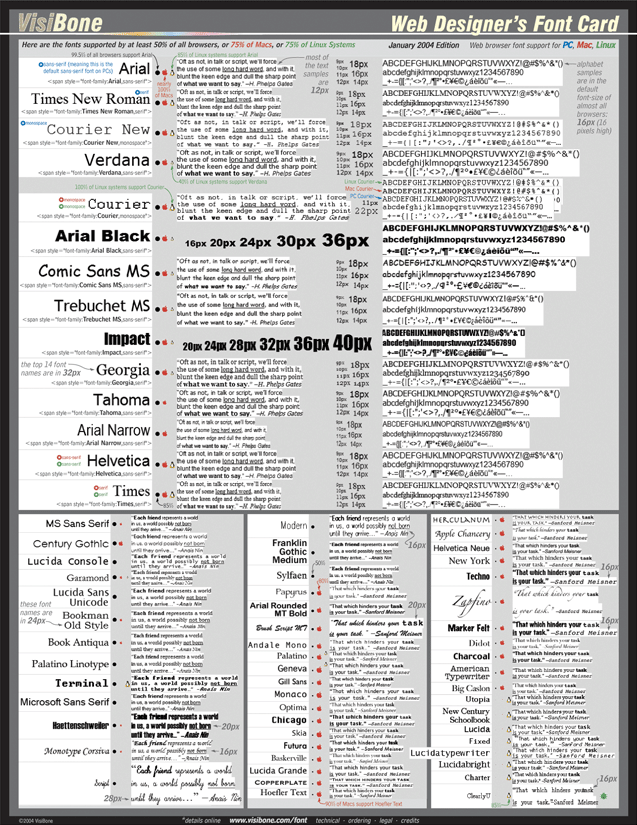


- I implemented new versions of the boxes as simple templates of the form {{stage|25%|Jan 16, 2005}} (giving Template:Stage) or {{stage short|25%|Jan 16, 2005}} (giving Template:Stage short}. When you now hover over the pictures, they show what the mean. The version including the date also shows, when this assesment was last made. Please read throuth Help:Development stages first and then review books on the bookshelves by yourself! --Andreas Ipp 07:43, 16 Jan 2005 (UTC)
Main page vandalized
The main page has been vandalized. I don't know how to revert a page to its previous version (short of cutting and pasting the entire previous version as a new version, which doesn't seem right), so someone else will have to fix it. — franl (talk) 20:14, 28 Dec 2004 (UTC)
- OK, I read the Help:Contents page and fixed the vandalism by reverting to the previously non-vandalized version. — franl (talk) 20:18, 28 Dec 2004 (UTC)
- At what point do we decide that the main page is too valuable to allow casual vandalism to disrupt it and therefore we lock it down (as I believe Wikipedia's main page is locked)? — franl (talk) 20:24, 28 Dec 2004 (UTC)
Can we rename "IT Bookshelf" to something more descriptive?
The IT bookshelf is poorly named. The term "IT" implies system administration or perhaps a focus on computers that excludes disciplines such as programming, graphics, networking, and compilers. What do people think of giving it a name that more accurately describes the range of topics that it includes? Maybe something like "Computing" or (more friendly) "Computer Technology"? — franl (talk) 19:05, 29 Dec 2004 (UTC)
- There should probably be a sharper distinction between the academic pursuit of computer science (i.e., college-level textbooks) versus general computing how-to books (e.g., learning Microsoft PowerPoint). Perhaps the name could be "Information Sciences and Technology"?
- I agree. While there is probably a spectrum of categories here, a simple two-way split between "Information Science" and "Computer How-To Books" (a lousy name, I know) is a good start. We should find names that are not implicitly translated by the reader into "computer books for educated people" and "computer books for uneducated people". The names should emphasize a focus on theory versus practicality. I think "Information Science" or "Information Science and Technology" is fine for the theory end of the spectrum, but I can't yet think of a good name for the practicality end of the spectrum. — franl (talk) 21:29, 29 Dec 2004 (UTC)
- I'm confused about the organisation of the 'IT Bookshelf' and the 'Computer Science Bookshelf'. At present, the IT bookshelf seems to be the global repository for IT/Computer related topics. Within this, there appear to be several other bookshelves (Computer Science, Programming etc.). However, within the IT Bookshelf, the 'Computer Science' listing does not link to the Computer science bookshelf or contain all of the Computer Science books. In fact, it contains some books that are NOT listed in the Computer Science bookshelf.
- I propose that the IT bookshelf is split into two as described above to distinguish between 'Information Science' and 'Computing' (or something more suitable). Within these two new bookshelves, further ' sub-bookshelves' would be created to house related books (such as Programming, Software Design', 'Operating Systems', 'Linux How-To's' etc.).
As I'm new to this, could someone explain how this might be undertaken? Presumably, it is not acceptable for one person to rearrange the site so substantially without consultation. Cheers, Robcowie 15:31, 20 Feb 2005 (UTC)
Redirect Template Delays?
I'm using a rather tricky mechanism so that I can get the Computer Science:Data Structures book to have two views: a view where each chapter is its own web-page, and a view where the entire book is a single web-page (for printing). To do this, I use the Template: area, where each template provides a #REDIRECT to the content page I want. Thus, I have some simple pages that just use the template by naming the page it wants: the single-chapter view pages include only the one template name, while the all-chapter page includes all template names. (You might want to visit the book to see what this looks like.)
The problem I'm having is that when I edit the content pages, the pages that use the templates (and the templates themselves are just redirects to non-template pages) are out of date. It seems only by editing the page to remove the use of the template, and then reverting it back can the page get updated.
So: Is this a bug and/or is there a work around for me to get something working? Thanks. --MShonle 04:17, 31 Dec 2004 (UTC)
- BTW, it seems other people (i.e. other browsers) can see the changes immediately. Perhaps it's a cache issue? MShonle 20:01, 5 Jan 2005 (UTC)
Reversed Numbers onStatistics Page
Over at Wikibooks' Statistics page it says, "There have been a total of 25043 page views, and 100243 page edits since the wiki was setup. That comes to 5.54 average edits per page, and 0.25 views per edit." Wikipedia's statistics doesn't have this very odd ratio. -- Everlong 14:22, 5 Jan 2005 (UTC)
Trying to Determine the Appropriateness of Creating a Wikibook
I'm brand new to wikis (this is my first edit), but I want to convert a concept paper to a wiki book so that others may contribute. I've been following various links to get some answers to my questions, but this website is overwhelming and I have to pick up my children soon. My questions are pretty basic:
1. Can wikibooks be used to publish a concept paper or project proposal (that's related to the development of an educational curriculum development project)? 2. Could a user of the content download the wikibook or wikicurriculum to be used in instruction when there is not internet access? 3. Oftentimes a professional wishes to share information anonymously (such as a doctor who has experience curing cancer without surgery or drugs and would risk losing his/her license by announcing the methods used). How can contributors be sure their participation cannot be tracked back to them?
Thank you
- 1. Wikibooks probably isn't the best venue for a proposal, and I'm not sure what a concept paper is. However, curriculum development would be great for a wikibook. For example, you can create a Lesson Plan as a book.
- 2. You can save the web-pages to a USB memory stick or a CD-ROM. Also, you can print out the pages.
- 3. Free speech is more powerful than you think. You can tell stories all you want so long as they are not calls to radical action. You can be indirect and relay the information as coming from some anonymous source and put a warning on it. Just be sure to make room for plausable deniability, though you really have nothing to worry about. I'd recommend legal council if you really are that worried. MShonle 20:15, 5 Jan 2005 (UTC)
- On point 2, I think it would be a good idea to allow some sort of single-click download of an entire book. Some of the more mature texts could take quite a bit of time to download completely with the current system. =P --Aurochs 20:28, 21 Mar 2005 (UTC)
Move to talk
I suggest to move all the talk from this page to the corresponding "talk" page. This page could contain a short and informative FAQ (with content from "Summarized discussions") and a prominent link to the corresponding talk page. I'd do it by myself, but since I'm not around yet here for a long time, I don't want to step on anybody's toes... --Andreas Ipp 09:42, 16 Jan 2005 (UTC)
- Perhaps the FAQ should be on separate page, and those issues addressed in the FAQ can then be archived on a talk page (or an archived talk page). Issues that are moot could similarly be archived. The staff lounge page could link to the FAQ at the very top. However, I like open nature of the lounge as it is now... too much indirection will mean a drop in participation. MShonle 23:07, 16 Jan 2005 (UTC)
Responsible for print css
Who is responsible for the print CSS? I'd like to add a box to my project, that does not show up on print, just on screen. I looked at the Wikibooks commonPrint.css but didn't find any generic class ".noPrint" or something like this. I could just use a class <DIV class="top"> to mimic this behavior, but it is not a clean solution, as top might in the future also have other stylistic properties that I don't want to inherit. Any idea, who could change the CSS file mentioned above? It would be a simple one line addition to the CSS file. (adding it to my private CSS file would not be of much help, since I want to use this property in a book for everybody). --Andreas Ipp 09:42, 16 Jan 2005 (UTC)
HTML Now gone Wacko
Something has changed (in the last day or so) all the HTML coding, changing tags like <big> to HUGE. What gives. Is the software running amock? - marsh 05:11, 20 Jan 2005 (UTC)
Wikibooks should have subpages on main namespace
I think we need the software to know about the book structure. Have you read m:Wikibooks should use subpages? ManuelGR 19:14, 21 Jan 2005 (UTC)
- Done. Now we can use subpages as in Wikijunior Big Cats/Lion. ManuelGR 18:02, 29 Jan 2005 (UTC)
Looks like vandalism
Take a look at the edits made by User:152.163.100.138. These edits were made to the chapter Algebra/Function graphing. These are the only edits made by this User under this number. It looks like nonsense to me. Is this vandalism? Should this User:152.163.100.138 be suspended or banned? I understand that sometimes legitimate Users have the same numbers as vandal Users, so I don't know the perfect solution to this problem. I reverted the edits made by this User. H Padleckas 18:56, 27 Jan 2005 (UTC)
Books all jumbled together and not distinct
I've been working on the cookbook. Every recipie has a link to "Catagories". Oh my. I click on that, and I see...
- Abugida writing systems
- Ada 2005 feature
- Ada programming language
- Algebra
- Anthropology
- Arts
That's just the letter A. While algebra may be useful for modifying a recipie, it really does not belong in a cookbook. Catagories from unrelated wiki books should not be leaking into the cookbook. I suspect that the Ada programmers have no use for Albanian recipies, but they can always just go to the cookbook if they get hungry. They don't need to be tempted by delicious Argentine recipies while trying to learn about Ada 2005.
Catagories should work within the cookbook and only within the cookbook.
Strange non-cookbook stuff also leaks into the "recent changes" page. I also get it if I use the "random module" link, which really should be "random recipie" and "random ingredient".
The only thing these wikis might reasonably share would be user accounts, and THAT is not working, at least between Wikipedia and the cookbook. Oh, the suffering. :-(
BTW, adding "Cookbook:" to all the links gets old fast. Because of this, and case-sensitivity being enabled, one is required to use the "|" to rename all links. This greatly detracts from the ease-of-use that wikis are known for. If the cookbook were more distinct, this prefix would not be needed.
I certainly do understand why things are the way they are. This does not change the simple fact that things are a great big mess.
The cookbook seriously does need a domain name for itself. Then some server-side bot can go through and rip out all the "Cookbook:" prefixes that are hurting usability.
The Special:Specialpages stuff is unusable too. For example, I look in the New Images gallery and see nothing about the cookbook. The cookbook gets drowned out by physics and biology. Everywhere I look, wiki features are unusable, with cookbook data being crowded out by unrelated stuff. Everywhere I look, there are links that take me to some generic place outside the cookbook. Even Main Page is misleading and wrong, and the reason why every cookbook recipe has to include an explicit link back to the main page of the cookbook.
AlbertCahalan 04:51, 2 Feb 2005 (UTC)
- I think you have follow the link to all the categories, instead of Category:Cookbook. Maybe is a bit misleading for the user to have a link to all the categories (Categories:) in all the pages. You should follow the link after Categories:, in this case Category:Cookbook. I think we should not use a different for every book ever written. We should instead improve the way we structure the books. For example I have been a proponent of the activation of subpages in Wikibooks. Fortunately you can now name the pages like Wikijunior Big Cats/Lion and you get an automatic link to Wikijunior Big Cats. About easy linking, at least you can use /Lion from Wikijunior Big Cats and you will get a link to Wikijunior Big Cats/Lion. Consider using this convention for the Cookbook and some problems will gone. To check the recent changes for Cookbook pages you can use the "Related changes" feature: [3]. Hope this helps. ManuelGR 20:33, 2 Feb 2005 (UTC)
- I did follow the link to all categories, first because it was there in plain sight, and second because that is what I wanted... restricted to the cookbook of course. Going to Category:Cookbook would not get me all the cookbook categories. In fact it only has three (cooking techniques, ingredients, recipes). None of those are complete either, and they won't be unless each and every cookbook category is manually added. I want the full list, as it exists in the wiki database, not something maintained by forgetful humans. This is exactly what the Special:Categories link is supposed to do and in fact does, except that non-cookbook stuff is leaking into the list.
Need better use of categories for organization
Obviously, some of the Wikibooks cover extremely different topics and are of interest to different people at different times. For example, I recently stumbled on History of Elven writing systems:Foreword (that's the Lord of the Rings writing system), which seems surprisingly detailed and informed, but it really should be separated from books on calculus and the like. I think that the first division of books should be by the broadest possible genre; split them into fiction, reference, and textbooks ("textbook" is loosely defined as any book that tries to teach, reference books provide data). I think a such a sweeping division could help keep wikibooks organized. If books are not put through several layers of categorization, they will become quite disorganized. By "several levels of categorization", let me give you an example of what I mean; History
- prehistory
- world
- primate to primitive man
- development of tools
- development and spread of ethnicities
- prehistoric civilizations
- early development and spread of writing
- Africa
- Asia
- Australia and Oceana
- Europe
- Americas
- world
- ancient to medieval
- Mesopatamian civilization
- Asian civilization
- Egyptian civilization
- Greece
- Rome
- Medieval Europe
- Medieval-era Asia
- modern Europe
….ect each of those items can easily be a book, and it would be horrendous to pile each of the sub-categories into one giant index that improperly acts as a directory. The Dewey system is great, but it looks almost entirely unused. No matter what way wikibooks uses to organize, we need to start doing it quickly. Visitors have good reason to assume this site is organized as well as a library, and we shouldn't dissapoint them. -Chris Edwards 23:43, 6 Feb 2005 (UTC)
- Hi Chris, I also agree with you that a good organization of Wikibooks would help readers quickly find the book they like to read. But I would refrain from adding a new layer on top of everything: Rather, categorize the books that already exist.
- Wikibooks develops quite differently from say Wikipedia where a one-page stub could in principle be easily filled. Not so the books - they need time for writing, and during the next two years, maybe there will be somebody writing about your Mesopotamian civilization, but for years to come, say, Asian civilization, Egyptian civilization and Medieval Europe as some books you suggested will just stay empty.
- Therefore I would suggest to categorize the books that already exist, assigning development stages Template:Stage short to make it easier to see how "complete" a book is, and present the more complete books as prominently as possible on the bookshelves.
- As to your suggested division into fiction, reference, and textbooks: Wikibooks was originally meant to be for textbooks, which does not allow for newly created fiction. Reference would go to Wikisource, as well as would old fiction that falls out of copyright. Of course, some books here on Wikibooks go beyond what would be taught at schools, that's why there is the Miscellaneous bookshelf.
- I would put the major focus of categorizing books into the bookshelves, since they are the broadly used and an easy way to categorize the existing books of Wikibooks. Both the Dewey system and the (Wikipedia) categories didn't find the crucial mass yet, but you are more than welcome to fill those gaps as well.
- But if you ask me, for the current stage of Wikibooks, the bookshelves are the best alternative, like in a small village library: You sort the books you have, and place them tidily - you don't buy empty shelves, put labels on them, and wait for a few years until somebody will come to write a book for that shelf... --Andreas 09:44, 7 Feb 2005 (UTC)
Special:Wantedpages not being updated, and raw wikitext
It says "The following data is cached and may not be completely up to date", and no kidding! Nothing is said about how often updates occur, when the last update was, or when the next update will be. I think at least a week has passed since I noticed the problem. When I saw the note about caching and all, I figure there is probably a continuous or frequently scheduled (like, every 5 minutes) asynchronous update. So, what is it, monthly? Yearly?
I could really use this data. Better yet, I'd like all the non-cookbook stuff filtered out.
As an alternative, is there an easy way to get raw wikitext data? With that I could do lots of useful stuff, like generate a proper index.
AlbertCahalan 03:07, 8 Feb 2005 (UTC)
Candidates for Speedy Deletion
Will an administrator please visit this page post haste? Some of the pages there have been around the list for a year or more.--Naryathegreat 04:11, 17 Feb 2005 (UTC)
- I have a few procedural questions though - the whatlinkshere on VfD needs to be absolutely clarified. Why is the Get rich quick book a speedy?
- Some can't be deleted because the revisions are block-compressed. Admins can't do anything about that. I've cleared out what I could.
- Dysprosia 09:46, 17 Feb 2005 (UTC)
- Perhaps "get rich" is there because it should be moved to wikisource? MShonle 14:45, 17 Feb 2005 (UTC)
- I'm working on a solution. --Naryathegreat 01:25, 18 Feb 2005 (UTC)
Important Change!
Done! Now you just you the following format: '''{{Delete|Your reasoning here}}}'''. Hopefully this makes it easier.--Naryathegreat 01:33, 18 Feb 2005 (UTC)
Moving books
I have been an anonymous browser for a few weeks and noticed today that there are books in the History bookshelf that need to go to Humanities/History.
I'm willing to do some work on that, but I see that there is about a month to go before they would be deleted and I would rather maximize my time working on the moving than working out how to move.
I've checked the Help section and seached as I could and continue to have a hard time with it.
Also I don't want to step on toes.
Am I missing a procedure/tool for moving books to a different shelf? (Right now I'm considering creating a book from scratch and copying and pasting.)
Also am I missing where others might be working on this as well?
erraunt
- Hi erraunt, thank you very much for your great interest in helping to clean up Wikibooks. "Moving books" between bookshelves is meant to be a straightforward task: First copy the entry to the new bookshelf, and then delete the entry from the old bookshelf. You don't have to touch the book at all, just the link to it gets moved.
- There is no point though, in doing this blindly: If you take a look at the books in the History bookshelf, most of them are in a rather incomplete state.. somebody came up with an idea for a book, wrote a page, and that's it. Some other books (like U.S. History) are excellent books. First-time users might get easily frustrated by the incomplete books, and never make it to the better ones.
- So, more important than moving books is actually to give development stages to the books. Have a look at the books, and look into all chapters, and provide "development stages" by the template Template:Stage short, where you can give 00%, 25%, .. 100%. If you did so for a book, go back to the bookshelf, and provide a development stage there as well: Template:Stage (here with the date). It is all explained in development stages. Have a look at the US_History/Contents page to see, how it should be done.
- Only after you gave such development stages, you might move the book to one of the active bookshelves. If the book really looks like a stub, and nobody worked on it for more than 3 months, then give 00% Template:Stage and move it to "Suggested Wikibooks". Otherwise you can list it on "Active Wikibooks".
- There is no point in moving empty books. So, first look into the books, and try to estimate their quality. If you have further questions, feel free to ask anytime. --Andreas 18:36, 1 Mar 2005 (UTC)
Hi andreas, thank you much for your reply. I'll do some digging and follow your advice.
- So perhaps I've missed something here, but how would we go about moving something (say, A.Einstein,_Zur_Elektrodynamik_bewegter_Körper._Kommentiert_und_erläutert. that's quite obviously in another language (German, in this example) from en.wikibooks.org to de.wikibooks.org (or es, or fr, or what have you)? A prompt response would be appreciated, as it seems that quite a few "orphaned" books are merely on an inappropriate language's site. Thanks guys n gals! -- Orethrius van Degaurde, 03:04 UTC, 07 May 2005
Capitalisation in Cookbook ingredients
Shouldn't ingredients in the wiki cookbook be in lower case? For example, if I'm adding a recipe and want to create a link to flour, I need to use a capital F, which results in the syntax:
- 100 grams of [[Cookbook:Flour|flour]].
instead of the simpler
- 100 grams of [[Cookbook:flour|]].
I created Cookbook:sugar as a redirect to Cookbook:Sugar, thinking this was an error, but I've realised that most ingredients suffer from this problem. I suggest moving all ingredients to their lower-case versions, but this might be controversial. Thoughts? --HappyDog 01:00, 3 Mar 2005 (UTC)
- No, nearly the opposite should occur. We should be using title case: "Beans and Rice", not "Beans And Rice" or Beans and rice" or "beans and rice". The names do indeed get used as titles for the pages. I fully agree that it sucks to need the funny syntax. This is because the wiki was set up as case-sensitive, and because the Cookbook is currently stuck sharing a wiki with unrelated stuff. AlbertCahalan
- HappyDog, capitalisation would work as you expect if Cookbook: were upgraded to be a real namespace. ManuelGR 22:52, 30 Mar 2005 (UTC)
- True, it would, but for the time being it isn't, so I guess we're stuck with it. Out of interest, why do you suggest that 'Beans and Rice' is the correct capitalisation for ingredients? It is the complete opposite of Wikipedia naming convention (names are capitalised, other items are in lower case). I understand why this should be the case for named recipes, but not for the individual ingredients. --HappyDog 00:38, 31 Mar 2005 (UTC)
Wikipedia is fairly irregular about capitalization. Anyway, whatever you use will become the title of the page. It is normal to capitalize everything except the little words (articles and conjunctions and such), except to capitalize the first work in any case. So, some examples:
- A Nice Cup of Tea
- Corn Oil
- Cream of Tartar
- Moqueca de Peixe
- Toad in the Hole
- Favorite Beans and Rice
- Eating for Health
- Herbs and Spices
- Ceviche of Shrimp and Sea Bass
- Coq au Vin
- Crab Quesadillas with Mango Salsa
- Frog's Legs à la Parisienne
AlbertCahalan 02:12, 31 Mar 2005 (UTC)
- I understand that the names of dishes should be capitalised, but surely 'corn oil', 'herbs and spices' and 'eating for health' (and possibly 'cream of tartar') should use standard lower-case capitalisation? Also, I see what you are saying about first word capitalisation, which is how the software would treat the words if Cookbook was a real namespace (although it would in reality be case insensitive, so there would be no problem about making the links lower-case). I find it a little odd, but if that's policy for the cookbook, so be it. Roll on cookbook namespace! --HappyDog 14:09, 31 Mar 2005 (UTC)
Importing already-written textbooks?
Is there precedence for importing into Wikibooks already-written, never-before published materials? Such materials would be subject to further editing, as people see fit, but both the structure and contents are pretty much set (heroic reorganization not withstanding). Already-written because it was written before Wikibooks came into being. The book I have in mind teaches people Taiwanese. A-giâu 22:01, 5 Mar 2005 (UTC)
- If you are the license holder, that's fine. Of course, it would be nice to make sure your book is in wikitext. (i.e. properly formatted.) In what form is this book? DOC, PDF, TXT, other? r3m0t (cont) (talk) 00:01, 6 Mar 2005 (UTC)
- Currently .doc and .pdf. I'll have to find a suitable doc2wiki converter or else format it by hand. A-giâu 00:42, 9 Mar 2005 (UTC)
Development stage icons
Hi. The development stage indicators are brilliant and I'd like to use the icons on Wikiportal on Japanese Wikipedia. Could you tell me the license of the icons to reuse there? PD or GFDL? Thanks, e-Goat 12:47, 7 Mar 2005 (UTC)
- Hi e-Goat, (please, other wikibook users, correct me if I am wrong), since the icons have been changed by many people already (including Flonejek, Boit, Robbyjo, Karl Wick, Mshonle, Frazzydee) and NOBODY ever cared to put a license restriction on the icon, the default license applies which is GFDL. I guess you could even use the less restrictive PD, but in that case it would be safer to ask all the people mentioned above first for permission. You can upload the pictures to commons.wikimedia.org and automatically use them in the Japanese wiki. If you do so, all other language versions could use the images too.
- What I would recommend you, is to use the corresponding template (as described in Help:Development stages) as well: Template:Stage short or Template:Stage. You can translate them to Japanese, and they provide a "tooltip": automatic information if you place the mouse above them (try it out here: Template:Stage short ) which you don't get, if you just include the image. Additionally, the date is recorded when the development stage was assigned. This will help in future updates, and will help the reader to see how old an assessment of a page is. I'll gladly help with any questions about the templates. --Andreas 13:25, 7 Mar 2005 (UTC)
- Thanks for you infromation, Andreas. The icons have already been uploaded to Commons under GFDL. The template is also smart, so I will introduce it and its document. Thanks again. e-Goat 15:12, 8 Mar 2005 (UTC)
My browser does not interpret chinese letters.
I have a mozilla firefox webbrowser. Can I download some extra stuff for it to read chinese?
Please, help me. I really want to learn chinese.
regards, PB
New consistent naming convention recommendation
How many people think that we should officially recommend the use of sub-pages for new wikibooks? The page Wikibooks_talk:Naming_conventions lists several possibilities how books are organized so far, but I would really like to put a prominent recommendation on that page, that future books are strongly recommended to use subpages in a specific way.
- Most books use "Bookname:chapter" (either real namespace or quasi-namespace). Note that the maximum number of real namespaces is currently limited by the software (TINYINT(2)) to 256. Also there is no software support for sub-sub-structure.
- Some books use "Looooongbookname" and "shortbookname:chap1" "shortbookname:chap2". This is really difficult to organize for any kind of automatic book listing (like I do with the Wikibooks:Top active). It would be really better to have literally the same title on all pages
- Very old wikibooks use "..(Bookname)", but I guess this is clearly outdated. Some study guides use "Lord of the Flies", some use "Study Guide:Shakespeare", others "A Tale of Two Cities/Study guide/Themes"? I can not find the logic behind this, and neither do my SQL scripts...
- Subpages would force the author to use the same Book-Title on ALL pages, making it easy later to tell books apart. If one uses chapter descriptions instead of chapter numbers, one can also easily insert chapters into existing books (after all, wikibooks is expected to be a growing process).
- Subpages would automatically come with a link to the parent.
In some cases namespaces might make sense, but I think for the vast majority of wikibooks and wikibooks to come (we have several new books every week), I think that subpages would be the most natural choice. I'd like to know about other people's opinions before spreading a definite recommendation. --Andreas 15:08, 12 Mar 2005
- The best thing to do would be to have a number of schemes and then to put it to a vote. I'll open up a dedicated page for this at Wikibooks:Hierachy naming scheme.
- I'm not necessarily opposed to the subpage method, apart from using the ":" method adheres to the principle of least surprise. However, the / method may encourage a bit more hierachicalization than would be actually desirable (we may end up having subpages where the subpage only covers a small amount of content, which would destroy the linear nature of the book, and make things difficult to print, etc.)
- Dysprosia 06:12, 13 Mar 2005 (UTC)
- Hi Dys, I've updated your Wikibooks:Hierachy naming scheme significantly. Let us move future discussion about this point there. --Andreas 09:49, 13 Mar 2005 (UTC)
Module-izing: Request for Advice
I started a book on the How-To shelf: Down'n'Dirty Blacksmithing.
When I was fleshing things out last weekend I got a message that the page was now at 40(KB? I think) and larger than most browsers could edit.
"Time to break into modules," I thought.
But I'm not sure how, or how best to go about this.
I can think of a couple of possibilities, but I'm not sure how to do them or which would be 'best".
My ideas:
1) The core of the book is about setting up a simple workspace for blacksmithing. Excercises and projects with that basic workspace could get really bulky, but are also in demand. My first thought then is to make two books: "Down'n'Dirty Blacksmithing" and "Down'n'Dirty Blacksmithing: the Workbook". Then put an outline of excercises and projects in a recommended order and link to the workbook from the outline with redirects.
Downside is that there will likely be enough information to fill more than one Workbook.
Upside is that it would make the first book more focused and managable.
2) Put excercises and projects in Wikipedia under "How To" and link to those articles, similar to #1.
Downside: this could put a lot of fairly specialized stuff in a Wikipedia area that seems to be about simple procedures for the "lay person". Not sure this stuff is appropriate for there.
Upside: really keeps things in smaller modules that can be pulled together into larger things. I like the apparent efficiency of this and using the right sections for the right work.
3) Set up a "sub-bookshelf" if possible and put the excercises and projects as small books in there. I don't want to clutter "How To" with a bunch of small stuff on one topic, that seems less than tidy.
Downside: not sure how to create a "sub shelf".
4) Just make links to non-existant books and follow the links and build the books. If they aren't listed in the bookshelf they aren't seen.
Upside: simple
Downside: some might want to go straight to the specifics ... that could be useful. Somehow seems "untidy".
5) Something I haven't thought of???
Thoughts?
- Hi Erraunt aka Timothy. You put much effort into your book, and it is nice to see it growing so quickly. Here are my suggestions:
- Have a look at how other books on Wikibooks are organized (for example the quite new Hamster Care: The main page of the book only contains an introduction, and then a table of contents which links to the subpages of the book.)
- The table of contents leads to so-called "subpages" of your book (they belong to your book), and there are 2 ways of doing it currently: Either bookname:subpagename or bookname/subpagename. My personal recommendation is [[bookname/subpagename]] because it gives you automatically a link back to your main page, but this matter is still discussed at Wikibooks:Hierachy naming scheme
- Keep the book together: Have all in one place. You can organize your book though into different chapters and sections. Be careful not to make too many subsections: Create or split a new chapter or section only if it is necessary, avoid having many "red links".
- If you have separate exercises you might put them into an "Exercise" chapter, or into an "appendix".
- If you want, I'll help you to set up the first couple of pages. --Andreas 10:18, 18 Mar 2005 (UTC)
Thank you. I took your advice -- actually, started taking it before you posted it -- and I'm with you on your suggestions.
A bit busy this week actually doing some blacksmithing (weather got warm enough) so it might be next week before things start changing again.
Thanks again, both for the advice and the encouragement. erraunt 00:23, 22 Mar 2005 (UTC)
WikiBooks Spammer
I was just editting, and it said that I had a new message then I noticed that someone spammed me. I went to that user's page and figured that he does some spamming. Visit my talk page's history and read 221.196.99.2's contribution page. I hope you can ban him or something. thanks (and yes, I also posted on the Vandalism on Progress page) -- WB 08:46, 21 Mar 2005 (UTC)
"Annotated works" and "Study guide bookshelf"
This discussion has been moved to Wikibooks talk:Annotated texts.
Two Copies of Why use open textbooks
Why_use_open_textbooks? And Why_use_open_textbooks
The first one with ? at the end of it is a superior version in my opinion, but one needs to go.
-Arckanghel 03:33, 31 Mar 2005 (UTC)
Communications Category within Humanities
I'm not quite sure how to add one so I can place the textbook I started on it. Instructions appreciated because I cannot seem to find the help page regarding this.
--67.176.243.104 04:00, 31 Mar 2005 (UTC)
no-results-found page says "For more information, see $1"
If you search for a term that doesn't appear in any titles, e.g.
http://en.wikibooks.org/wiki/Special:Search?search=cyanobacteria
the "no-results-found" page says:
No page with this exact title exists, trying full text search. For more information about searching Wikibooks, see $1.
Looks like a bug where some variable isn't being interpolated correctly?
-Bennett (bennett@peacefire.org)
Wikimania!
Registration for Wikimania, the first international Wikimedia conference, is now open. It will be brilliant fun. Everone is invited to join the event this summer.
Wikimania will take place from August 4-8, 2005 in Frankfurt am Main, Germany. The event will combine Wikimedia community discussions and software hacking with academic research, presentations of current implementations, and user/community panels. Wiki fans, community members, and developers are all invited to attend.
Feel free to submit presentations and other content for the conference; for more information, see the call for papers.
Please pass this message along, in English or in translation. For coordination and translations, see our internal announcement oage. To let the rest of the world know, use our public press release.
If you want to help or have great ideas for the conference, please write us via the meta-feedback page, or just ask on the foundation mailing list. Attendees can coordinate travel plans and other informal events on the Wikimania community pages.
Wikimania is an event from the community and for the community - it will be brought to life through your participation and suggestions!
Looking forward to seeing some of you this summer,
- Sj 23:16, 4 Apr 2005 (UTC), on behalf of the Wikimania organization team.
New Wikistats report for Wikibooks
I'm glad to announce a new report for Wikibooks, generated periodically by the Wikistats job. You'll find here an overview of books, their content and some stats. I discovered there are at least 6 naming schemes for chapters. This made it difficult to automate extraction of chapter names, so in some cases the grouping of chapters may look a bit odd. I'm sure this will improve when the ongoing discussion about standardisation of article titles bears fruit. Please look at Statistics per Wikibook Erik Zachte 17:59, 8 Apr 2005 (UTC)
- Wow, there are lots of non-English books that are still on en. I wonder who will have to put all of that on VFD? KelvSYC 17:42, 9 Apr 2005 (UTC)
Images in WikiBooks?
I was looking through the Bicycle repair Wikibook and noticed there were no pictures. Is this just because nobody has submitted any, or is there some untold rule I'm not aware of where you're not supposed to use images in WB? Please cc my talk page. Thanks --RealGrouchy 18:44, 9 Apr 2005 (UTC)
- Thanks for the replies. I plan on taking pictures of bicycle parts and tools and uploading them and integrating them into the modules of Bicycle repair. --RealGrouchy 14:33, 10 Apr 2005 (UTC)
Logo text issue
I'm not a very active Wikibookian, so take this with a grain of salt, but I think the text on the logo could use a little retooling. It's always looked a little odd to me, and I think I just put my finger on what it is.
Specifically, the books are in perspective, but the text doesn't seem to be; the books are pseudo-3D but the text is 2D, aside from what looks like a tad of counterclockwise rotation.
Relevant (if old) links: Logo discussion, some discussion at Wikibooks:Staff lounge archive. Zach 20:08, 11 Apr 2005 (UTC)
I have created a system for nominating, selecting, and using a Collaboration of the Month. Although I am not an administrator, I am a regular and active Wikibookian. I hope this idea is accepted by the community as easily as the Book of the Month was. Because Wikibooks does not experience concentrated growth, I feel this is a mechanism for doing so.--Naryathegreat|(talk) 01:31, 17 Apr 2005 (UTC)
- I gave an extensive answer on Wikibooks talk:Collaboration of the Month. --Andreas 09:11, 17 Apr 2005 (UTC)
navigation bar to the left misses "Community portal"
Who can change "Wikiversity" on the left navigation bar back to "Community portal"? (see also my comment on Talk:Main Page#navigation bar to the left misses "Community portal") --Andreas 16:38, 17 Apr 2005 (UTC)
Drink recipes
I am considering transwiki-ing a Wikiquote article to Wikibooks because it is actually a recipe for a cocktail, but I have been unable to find any hint that Wikibooks is interested in drink recipes. It seems to me that it might belong to a chapter of Cookbook, or perhaps its own book on Mixology. Has this topic been raised yet? How do Wikibooks editors feel about this? — Jeff Q (talk) 03:18, 21 Apr 2005 (UTC)
- Put it in the Bartending book please. (if you bother to transwiki it) This stuff really clogs up the Cookbook with name conflicts. AlbertCahalan 03:50, 21 Apr 2005 (UTC)
Admins
Some of us are waiting around for votes on Wikibooks:Requests for adminship for a while. Just trying to get some attention... - Omegatron 13:33, 21 Apr 2005 (UTC)
Navigation
Has there ever been any discussion about next/previous functionality for moving from chapter to chapter? Either software enhancements or special templates. - Omegatron 13:44, 21 Apr 2005 (UTC)
Community Portal
I created a Wikibooks:Community Portal similar to Wikipedia's. Please add any links you think are missing, and add books to the Template:Opentask template. --Andreas 19:39, 24 Apr 2005 (UTC)
How to learn to fly
This has been started by a new user who has built up a large resource that he would like to transfer to Wikibooks (he contacted Jimbo about this originally). Some of the content will need adapting, some looks ideal. He has transfered the contents page to How to learn to fly, but needs some help with layout, wikifying, and transfering the rest. He is very new to wikis, and will probably not find it that easy to use, so could really do with some help. Is there anyone interested in giving this guy a helping hand, and getting this going? I can put you in contact via email, his site is at http://www.whittsflying.com/ . -- Sannse 10:34, 29 Apr 2005 (UTC)
- Err, I took a look at the page, right now it's really just a very big mess of supposed content links. He does have the actual content right?
- I suppose I can help to sort out the contents page and set up the book structure (rather slowly, I have my hands full with the wikibook I'm working on. :), but if there is no content forthcoming then it's kind of pointless... -- Lynx7725 03:13, 11 Jun 2005 (UTC)
See the discussion tab at the Wikiversity School of Aviation (http://en.wikibooks.org/wiki/Talk:Wikiversity:School_of_Aviation) for an annotated list of public-domain and free sources of information about learning to fly that are already readily available on the Web.
suggested Speaker representing Wikibooks/Wikiversity
I am hosting a 1 hour panel discussion on K-12 Open Source development implications before a crowd of EDU software/content publishers and technology companies on May 24th in Los Angeles. I would be very interested in having someone who lives in California representing Wikiversity join this panel (along with Intel and a K-12 CIO) for this hour long presentation. I would like the Speaker to talk for 15-20 minutes about the development of Wiki content and how schools are welcoming this format along with taking questions from the audience.
I am posting this in hopes that someone could suggest specific individuals for me to contact ASAP about joining this panel.
Thank you Page Gravely Director, Global Education Services Red Hat, Inc. pgravely@redhat.com
Minor vandalism needs to be reverted
How do I get a page reverted to an earlier version if someone has made small, but deliberately, incorrect changes to it?
Example [NOTE: link no longer shows the correct diff. MShonle 00:11, 9 May 2005 (UTC)]
At what point do people get banned for this behaviour and is there a watchlist of such people (IPs)?
Marknewlyn 21:48, 8 May 2005 (UTC)
- I reverted the changes made and put a short block on the IP. There's no solid line drawn as when to block, or for how long. However, I consider these minor edits that degrade the accuracy or quality of wikibooks to be real acts of vandalism. Thanks for pointing this out. MShonle 00:11, 9 May 2005 (UTC)
- For an anon, consider user intent and computer connection type. Just a few hours will do for a dial-up connection, but you might as well go a bit past 24 (30 to 40 perhaps) in case of an always-on connection with a user who would reconsider their actions. If they clearly vandalize again (not a matter of opinion) and appear to be the same user, then you know they have a long-term net connection and an evil mind. Cable modem DHCP assignments often last for months, apartment leases are often 1 year, and university dorm assignments are often for 4 to 10 months. So, a year should cover that without leaving the IP address useless forever. AlbertCahalan 05:25, 14 May 2005 (UTC)
Capatalisation of Wikibook's pages
Okay, it looks like we need to kick off debate on capitalisation rules for Wikibooks again. AlbertCahalan and I have been discussing the issue on the talk page for Wikibook's manual of style. If you could please share your views there, it would be greatly appreciated. (Donovan|Geocachernemesis|Interact) 06:44, 15 May 2005 (UTC)
Helpful Guidelines Please
Hello all,
I am a college student with some free time this summer and am interested in spending a good deal of it working on a wikibooks project - I'd prefer to start from scratch and try to spend the summer getting a good start on a long, comphrehensive wikibook. I plan on using 5-7 textbooks as my basis and will construct my own from them. Beyond paraphrasing and quoting (which i will not do), what else should I avoid? If factual information is presented in all 5 books without sources, then can I assume it to be common knowledge and write my own interpretation of it (ex. 'Native Americans suffered great injustices under Jackson's presidency.')? I read through the copyright section but did not find general guidelines...
Thanks very much, Angad (please post responses or reply to adsingh@haverford.edu)
Stewards election
Hello,
The stewards election has started on m:Stewards/elections 2005. Anyone can vote provided that he has a valid account on meta with a link to at least one user page, on a project where the editor is a participant, with at least 3 months participation to the project. Stewards can give sysop right on projects where there are no local bureaucrate. Please vote ! Yann 14:40, 18 May 2005 (UTC)
Should I donate my book?
I am a real-live author. About ten years ago Motorbooks published my Codeword Dictionary. We sold about three thousand copies. (Which is not as good as having a million-seller, but better than having a million in your cellar.)
Here is an entry: ICEBERG (Allied 45) The American invasion of Okinawa on Easter Sunday, 1 April, 1945. The Japanese consider Okinawa an integral part of Japan, and so they defended the island using the same techniques they planned to employ against an Allied invasion of the home islands. The one hundred thousand defenders avoided the massive pre-invasion bombardment by establishing their defensive lines inland (TEN-ICHI). The resulting battle was the largest in the Pacific theater. The island was secured after eighty-two days, at a cost of over 107,000 Japanese soldiers and 150,000 local civilians. This was a rate of over 1,300 Japanese soldiers killed each day. At sea and in the air, the Japanese countered with a massive kamikaze attack (FLOATING CHRYSANTHEMUMS), sinking thirty-four ships, and damaging an additional 368. Over 7,500 Americans were killed on the ground, and another 5,000 in the surrounding sea. The deception operation for this invasion was BLUEBIRD.
If I post it here, will it preserved (and edited, I know) for ... ever? I would hate for my work to go away.
Further, if I were to post it, should I do so in one honking huge file, or about twenty chapters?
[[Paul in Saudi 04:04, 20 May 2005 (UTC)]]
- That sounds cool. I would double-check with Motorbooks first though. You may have signed something saying you wouldn't publish elsewhere. Also, I strongly suggest posting in pieces. In fact, the more you can break it down, the more user-friendly it will probably be. Isomorphic 04:15, 21 May 2005 (UTC)
No copyright problems I own the copyright. Still, I would hate to loose control of My Baby. (On the other hand, I am fed up with updating it.) [[Paul in Saudi 11:44, 21 May 2005 (UTC)]]
- I think you will prefer to publish it in Wikisource. Wikibooks is for writing new books collaboratively and Wikisource to publish books already published and in a final state. ManuelGR 20:07, 21 May 2005 (UTC)
Excellent idea Manuel! Let me go over there and poke around a bit. [[Paul in Saudi 02:32, 22 May 2005 (UTC)]]
What is the best hierarchy to incorporate Phlebotomy into Wikiversity?
I would like to create a study guide/book for phlebotomy, which is a subdomain of Allied Health, which is a subdomain of Health Sciences.
Phlebotomy specialists may work for Pathology/Lab Medicine departments in hospitals, for clinics, or for commercial laboratories. Phlebotomy techniques are used by nurses, medical assistants, and other allied health professionals.
Some alernative hierarchies are:
- Life Sciences -> School of Medicine -> Allied Health -> Phlebotomy
- Life Sciences -> School of Medicine -> Phlebotomy
- Life Sciences -> School of Allied Health -> Phlebotomy
What is the best hierarchy to incorporate Phlebotomy into Wikiversity?
--Jwalling 03:20, 29 May 2005 (UTC)
Board Election 2005
Hi, Board election has opened and we'll accept candidate from the next monday, July 7 on meta. The votes will start at the end of month. Further information is available on m:Elections for the Board of Trustees of the Wikimedia Foundation, 2005/En in several languages. This election is very important: we vote for our own representatives to the Board. If someone put a link to this page on Recentchanges, it would be very much appreciated. --Aphaia 08:37, 3 Jun 2005 (UTC)
Templates and Backlink Expert Wanted
In the books I've been working on I've been using a system where things left undone are noted in the text as a TODO item. Something like: [TODO: Insert figure of the nodes connected here].
What I'd like to be able to do is to change these suggestions into something that uses a template: {{:todo|Insert figure of the nodes connected here}}. The text itself would have some kind of nice, boxed rendering, and then the item (and the module name in which it appears, perhaps subsection too?) would appear on an automatically generated Todo List. That way, contributors can check the todo list for tasks remaining. When the template is removed, the item is taken off of the list. (Perhaps lo/med/hi priorities could be assigned to todo items, to also help contributors.)
Is this technically possible? Thanks, MShonle 00:03, 5 Jun 2005 (UTC).
- Backlinks and categories can show which pages have a todo tag (see e.g. w:en:Category:To do) but not the content. To have an overview of todo contents each page can have an associated todo page, and a page has to be created transcluding all these todo pages.--Patrick 06:43, 6 Jun 2005 (UTC)
- Alternatively, the todo contents can be in the name of a page that is put in Category:Todo, e.g. User:Patrick/Wikibooks:Staff lounge:todo: discuss todo system with Mshonle, use category or backlinks, or perhaps pages with a long name like this one.--Patrick 20:38, 6 Jun 2005 (UTC)
- Thanks! I'll test some things out. (When the time comes around to me again.) MShonle 15:25, 10 Jun 2005 (UTC)
correct font formatting?
I'm currently experimenting with using an almost authentic font for the headings a game guide I'm editing, for example this page, Grand Theft Auto: San Andreas/Appendices/External Links.
Now right now I've used <font> tags, but higher up in the lounge (#Non-English Fonts) I see reference to using a div tag.
But isn't the font tag older and thus more compatible, or does MediaWiki automatically convert div into font or something?
Then again, is using tags for purely asthetic additions not a good idea?
Anyway, thanks in advance! Master Thief Garrett 04:45, 9 Jun 2005 (UTC)
- It's not about back-compatibility. The font tag was deprecated a long time ago in favour of CSS, and is now removed from XHTML. The correct way of changing fonts is by using the style attribute. Typically...
<p style="font-family: something">paragraph</p> or

<div style="font-family: something">vertical division</p> or

<span style="font-family: something">horizontal span</p>
- ...although the style attribute is applicable to many other elements. It is also recommended that if you intend to use a specific font by name (e.g. a Windows TTF font), you should also specify alternatives, should the user not have Windows. See the source for this template.
- Aya 23:44, 23 Jun 2005 (UTC)
Breaking up particularly large wikibook modules
I'm currently in the process of writing some modules for a Wikibook that has become quite large. The example is the following Wikibook: Serial Communications
Where I'm having difficulties is that one of the sub-modules is currently 73KB in length. I would like to try put that into more bite-sized chunks to get that to be more managable for editing purposes. The problem I'm encountering is that I would also like to keep this module as a "chapter", in terms of how the wikibook is going to be read, and from a reader's viewpoint (rather than a Wikibookian who is trying to edit content of the module) I would like to keep this material all together as one continuous chapter.
The question then is: What would be some alternatives to break down a module that is particularly long?
- Break into sub-chapters. This would treat the module as the jumping off point to a bunch of sub-modules that cover a specific point of what I'm trying to cover. I don't like how that would breaks the flow of reading the "book" however, and turns it too much into something like Wikipedia, but corrupted. I am trying to write a book here, not encyclipedic articles loosely linked together.
- Use Templates for "logical sections" and put the module together as a collection of templates. This would keep the material together, but I see that as an abuse of templates, and much more intimidating for a new user to try and make an edit. It does allow, however, for the "large module" warning to go away, and it makes the whole chapter fit together from the viewpoint of a reader.
- Ignore the warning and keep the large module. This isn't satisfying in the sense that I think the 32K warning for module size is a legitimate concern. There are legitimate problems when you try sending large amounts of content through a web posting request via http, and the technical side does have some limitations that suggest large modules should be avoided if possible.
Any other suggestions? Added comments?
- Break into subchapters. Yes you're writing a "book", but even if printed on A3 paper you still have to turn the pages once in a while! Therefore a digital equivalent can be similar. As long as the pages are seamlessly linked with whatever formatting standard you've chosen to go with at the top and bottom of each, it should not feel too disjointed.
- An example of a navigation header would be my recent solution for the Turf Wars and 178 Territories Glitch sections of the Grand Theft Auto: San Andreas game guide. I was forced to divide the Turf Wars explanation into two (with the additions I plan it will go way over 32kb), but the two pages are still clearly linked to each other and each refers to the other at various points. Also note the italicised disambiguation at the top so if you've come to the wrong section because it sounded very similar you can quickly find what you were really after.
- A bit of math tells me your 73kb could divide into four nicely-sized 18kb pages (give or take). So it wouldn't be too hard to sacrifice the flow for a break, and it would still load nicely. Of course you could just divide it into three 24kb sections, but it wouldn't take many additions to put those close to the premium limit once more. If you're going to bear the pain of a split, at least choose a method where you only have to do it once!
- Hope that helps! Master Thief Garrett 14:29, 9 Jun 2005 (UTC)
Any template compilation page?
Is there a collection of Templates anywhere on Wikibooks? I know on Wikipedia there's a page listing all the various {{stub}}s and more pages listing other Templates. It would be useful to know what exists already, like {{cleanup}} and {{VfD}}, and to see what we still need. {{split}} comes to mind. --Everlong 12:20, 10 Jun 2005 (UTC)
- There is http://en.wikibooks.org/w/index.php?title=Special%3AAllpages&from=&namespace=10 , and Wikibooks:Template messages, showing some.--Patrick 07:43, 27 Jun 2005 (UTC)
HELP NEEDED FOR SIMPLE ENG. WIKIBOOKS!!!
Although the Eng. WB is going well, there is hardly any content on the SE version [4]. The project needs content urgently, and also to set at least one person up as an administrator. There is currently no admins and so no control.
Could we get some textbooks written, as well as some other essential features such as:
- Community portal
- Help desk
- Ability to block vandals etc.
- Wikiversity
If anyone could start on this project it would be great. Thanks! Charlie123 14:07, 23 Jun 2005 (UTC)
Navigation
I noticed when trying to read some of the content here that you can't actually read any of the books here like you would an e-book. That is there is no next page or next section functionality. I suspect this has been discussed somewhere but I wonder if it was a conscious decision requiring excessive use of the back button to read these books or if it is a technical problem that is still looking for a solution, or perhaps I am missing something significant and this sort of thing can be done I just failed to figure it out. It strikes me that any page that requires the use of the back button for normal navigation/usage is a poor user interface, it prevents the user from becoming really involved in the books and acts as a barrier to the sections fitting together in logical ways. If this issue has been discussed could someone point me to it? Dalf 20:43, 23 Jun 2005 (UTC)
- eeep ..... minor use of my browsers find feature and I found mention of this on this very page. Still no resolution just a few people asking the same question. From the looks of it its a technical/convention based problem at this point. But, one I think should be solved to differentiate wikibooks from being just a collection of related wikipedia articles on a single subject grouped together. If the pages are done by chapter and not section then its a simpler problem because you are less likely to have sections inserted between other sections which would require a more complex TOC based solution. Dalf 20:48, 23 Jun 2005 (UTC)
21 Century Math
21 Century Math: This seems to be an obscure project. Please look to the webpage. I propose to delete it.
- Can whoever proposed this actually tag the relevant article with a VfD tag and put up for discussion on the Votes For Deletion page? - Lynx7725 6 July 2005 07:13 (UTC)
Picture questions
A couple of questions about pictures...
- Is there any way of linking to pictures on Wikipedia or do I just have to download them and upload them to wikibooks giving the correct credit and info as necessary?
- Am I right in thinking that in general I should be ok taking screenshots from Microsoft Excel for a wikibook, under the fair use policy I think I can as it's for teaching purposes, can anyone confirm/deny this?
--PhysicsFan 18:07, 26 Jun 2005 (UTC)
- If the image is on the Commons you can crosslink it (visit the Image: page and you'll see "this is from the Commons) or whatnot.
- Alternately, you can create a template on WP to make crosslinking to any other Wikimedia project possible, but I'll have to look that up again. I'll get back to you on that soon. :)
- Remember, "fair use" claims is tentative at best, and it's supposedly the job of the uploader to assess the fairness of each and every item. Wikibooks currently has no fair use policy, at least not in words like Wikipedia does. In this case I would say it's fine claiming it for teaching purposes, and, as such, might even inspire sale of the software. And it's not like your reproduction is taking away from the value of the purchased item in the way an artwork would. People have already been adding screenshots to game guides here and no-one's tearing their hair out, so I'd say just go ahead until something's down in writing! Master Thief Garrett 00:54, 27 Jun 2005 (UTC)
Request for extra eyeballs
I'll be away from my keyboard for most of the coming week, because I'm going on holiday. So, would anyone who has a chance please look over recent changes list from time to time to eliminate any link spam and newbie tests that you find (not that you guys aren't doing that already ;). The more eyeballs we have looking the better, because it's easier to eliminate spam when it enters Wikibooks than it is to do it later. (Donovan|Geocachernemesis|Interact) 03:56, 1 Jul 2005 (UTC)
- I'll see what I can do, but yeah, we need more eyeballs, preferably with a brain attached. - Lynx7725 04:59, 1 Jul 2005 (UTC)
- I don't mind pitching in too. Need a break from writing about Grand Theft Auto anyways. Aya 16:04, 1 Jul 2005 (UTC)
- Thanks Aya, but it looks like GTA tends to draw the hits.... ^_^; I've pretty much scanned all the way back to 01 July 2005, think most if not all vandalism has been caught. - Lynx7725 4 July 2005 11:39 (UTC)
- Quite possibly the case. That Wikibook has been heavily advertised on the GameFAQs forum recently, and it seems for every sensible submission we receive, there are about ten newbie experiments or vandalism attempts. Not really much we can do about it, especially considering the GameFAQs forum is predominantly inhabited by young male teens, whose sexually-oriented vandalism attempts on this site (e.g. "[ suck | lick ] my <insert body part here>") can only be attributed to an excess of testosterone. I'm still keeping an eye on things there though. - Aya 4 July 2005 15:26 (UTC)
- I did leave out a couple that should be deleted though... brain-fried. - Lynx7725 4 July 2005 11:39 (UTC)
- If you're referring to new pages created with meaningless content, I've added some to the speedy deletion candidates, but I'm not sure it's worthwhile, since very few of the people who can actually do something about it seem to be active, and in the case of GTA, if the page names are correct, I'll probably fill in the correct info later on, and delete the spam in the process. - Aya 4 July 2005 15:26 (UTC)
HELP! I'm getting swamped by the large numbers of edit today. More eyeballs are needed on the ground! - Lynx7725 6 July 2005 07:08 (UTC)
Restructuring of the Front Page of Wikibooks
I am providing a more detailed explaination on the Talk:Main Page, and please post comments there as well. The point I'm trying to make for people who don't frequent that page is that there is a need to restructure the bookshelves somewhat. The IT Bookshelf has been split between three different bookshelves, based on discussions at Talk:IT bookshelf. It is something that has been needed for some time, but has created a few minor problems on the front page. I'm just asking for some advise on how to proceed, and advertising here in the Staff Lounge.Rob Horning 19:09, 2 Jul 2005 (UTC)
Contributions not tracking correctly...
Hello. I set up an account on Wikipedia, and then I made some changes to a WikiBook here that didn't show up in my list of contributions until I created an account here also.
My contributions all show up in the history as coming from my static IP "24.87.56.253." How do I go about getting this fixed so that:
1. These changes (all done today) will show up in the "my contributions" section; and, 2. The history of the book will show "Randolf Richardson" instead of "24.87.56.253?"
The Book I've been making changes to (as I follow the tutorial) is: http://en.wikibooks.org/wiki/Blender_3D:_Noob_to_Pro
Thanks in advance.
Randolf Richardson - randolf@inter-corporate.com
- Pardon me for asking the obvious, but have you logged into your named account yet? If you are not logged in (or logged out previously, or did not ask the computer to remember your login), the system would automatically put your contributions under your IP.
- I did set up an account, on WikiPedia, and then I didn't realize at first that I was on the WikiBooks web site later on which doesn't seem to use the same accounts -- I had to create a separate account on WikiBooks as well.
- And I'm grateful that you got a named account; patrolling the edits for vandalism and newcomer tests is a lot easier when you see a name instead of an IP. - Lynx7725 6 July 2005 07:11 (UTC)
- You're welcome. I'm using my real name.
- I suspect that one of the reasons you probably see so much of that problem may be party due to users not realizing that WikiBooks and WikiPedia are entirely different systems. My suggestion is to change this so that these two link to one another, although I suspect this probably isn't a small task (thus I sympathize with any reason for it not being implemented as a top priority).
- In the meantime, it would be helpful if the system could at least give the user the option, upon login, to re-assign all changes made from the current IP (say, in the last 5 hours or so) to their account (the database should keep a flag to indicate that this import occurred, just in case logging is needed as evidence in a future court case involving libel in the future, thus it could be considered that it is possible the user imported someone else's works unknowingly).
- I hope these ideas are helpful. It's really too bad there's a "vandalism" problem, but you folks must have the upper hand on it as I've not seen any vandalism so far. You've got a great system going here, especially impressive is the JavaScript wizardry I see just about everywhere -- I'm really impressed.
- Thanks in advance, and I will keep my watch open on this request forever in the hopes that some day my suggestion about synchronizing between the two systems might come to fruition.
Moved discussions
Archived Discussions
After some inactivity, discussions will be moved to other sections of wikibooks (such as FAQ pages), to the Staff Lounge Archive, or deleted (if of no long-term value). Some discussions recently moved to the Staff Lounge Archive:
- Writing Textbooks - Public domain books, Multilingual Wikibooks
- Guitar textbook, Physics textbook, Computer drafting (AutoCAD)
- Logo discussions : Wikipedia logo contest, our Logo page
- Wikibooks functional aspects -- Annotation mark-up, Q's about images, editable recent changes
- Cross-project references: Referencing Wikipedia & Wiktionary (also, see below)
- Server Issues and other Wierdness -- Login not working, Wikibooks namespace issues, TeX weirdness
Moved to other pages
- Wikiuniversity discussion moved to Talk:Wikiversity
- Wikibook Press moved to Wikibooks:Wikibook Press
- Namespaces lists and coordination at Help:Namespaces
- The Transwiki pseudo-namespace: our Transwiki log is up and running, and has it's first transferee already. Checkout m:Transwiki for more information. Gentgeen 19:55, 18 Dec 2003 (UTC)
- Annotated texts - previous discussions moved to Wikibooks talk:Annotated texts.
Summarized discussions
- Wikibooks: pages renamed to Wikipedia: -- fixed.
- Wikibooks.com not redirecting to Wikibooks.org -- fixed.
- Non wikipedian users: show them to Wikibooks:How to edit a page -- maybe we need to publicize this page better.
- Computer programming books -- Should this be broken up into seperate books? See Talk:computer programming.
- Link-cache troubles when using textbook.wikipedia.org -- use en.wikibooks.org instead.
- Bleh. Thanks for telling me about the Wikipedia: to en: to :w: syntax changes for trans-project links...
- Why are there no longer images in my Photoschule Großformat book? ... it works now. lars
- Are our textbooks designed to have a teacher? you can do it any way you want to.
- Why are Wikibook URLs case-sensitive? Tradition. Create redirects if necessary.
- How to protect a static page? Ask an Wikibooks:Administrator to temporarily protect it for you. Books which are truly static should probably go to Wikisource instead.
- Bad link in sisterprojects template -- fixed.
- There is a new Wikibooks:Portal.
- Are there criteria for Featured Books? There should be.
- The Design and Organization of Data Centers - now up.
General Help
- Categories & Topics: the convention is to use Special:Categories, though they are little used as of Aug, 2004.
- Language-specific subdomains & interfaces: Wikibooks:Subdomains
General References:
General Questions
- Is there a page here or elsewhere that describes how to set parameters and such for the template namespace? I can't find one.
- Is there a page on Wikibooks to get anon edits credited to accounts?
- I imported a 1910 manual of gardening and have been wikifying it. Take a look at the intro to gardening -- personally, I think it's well-written, but will need to be changed to suit Wikibooks. Has there been any discussion about how neutrality is relevant to Wikibooks, or what the desired tone of modules is?
- Could someone figure out why the three columns of links to articles on plants at the bottom of gardening won't line up? They are supposed to be next to each other, with the white one in the middle separating the two green.
TUF-KAT 26 May 2004 (UTC)
- Anyone know why the little symbol icons and the main logo have disappeared? - Marsh 9 Mar 2004 (UTC)
General Questions
- Is there a page here or elsewhere that describes how to set parameters and such for the template namespace? I can't find one.
- Is there a page on Wikibooks to get anon edits credited to accounts?
- I imported a 1910 manual of gardening and have been wikifying it. Take a look at the intro to gardening -- personally, I think it's well-written, but will need to be changed to suit Wikibooks. Has there been any discussion about how neutrality is relevant to Wikibooks, or what the desired tone of modules is?
- Could someone figure out why the three columns of links to articles on plants at the bottom of gardening won't line up? They are supposed to be next to each other, with the white one in the middle separating the two green. TUF-KAT 26 May 2004 (UTC)
- Anyone know why the little symbol icons and the main logo have disappeared? - Marsh 9 Mar 2004 (UTC)
How to link to Wikipedia and other sources
(see also Help:Contents)
Linking to Wikipedia
How do you link from a Wikibook to a Wikipedia article?
- To get a link to the Wikipedia article on apples, write
[[w:en:apple|apples]], [[w:en:apple|apple]]s or [[w:en:apple|]]s.
- To get to articles on other projects, use the following prefix:
w: wikipedia wikt: wiktionary q: wikiquote b: wikibooks m: meta-wiki
Numbers instead of words for external links
I tried the format [ http:// en.wikipedia.org/wiki/X X], but frequently got numbers instead of words! It didn't happen all the time, and I didn't specify I wanted numbers. Could someone please explain to me what's going on? --Trebor1990 (17 March 2004)
- If you use [URL] with just the URL in brackets, you will get a number (useful for providing an in text reference). To see WORDS, use [URL WORDS]. For example, [ http://www.google.com/ GOOGLE] comes out as GOOGLE. Theresa knott 17 Mar 2004 (UTC)
Wikibooks projects
Project Ideas
See Wikibooks:Project Ideas for more.
Proposed by various editors:
- Restaurant Guides
- Language learning
- Universal dichotomous key
- Manuals for free software
- Print and send (charity and non profit education to request printouts from old printers)
- Voting on ordering of arbitrary links of a wide choice such as on the freeware in Open_Source
- Songbook with sheet music
Bookshelf Ideas
See Wikibooks:Bookshelf Ideas for more.
Proposed by various editors:
- Social Science
- Game strategy guides
- Merit Badges
- Geography
- Interactive books using Flash, Java, javascript or Curl
The IT bookshelf seems to have grown to a point where it is becoming disorganised and difficult to navigate. My opinion is that all books contained within the current IT bookshelf should be assessed and classified as either non-academic 'computing' topics or academic 'IT/IS' topics. The former should then be moved to a new bookshelf 'Computing' (which already exists).
With a clear description of each bookshelf, and decent cross-referencing, I think it would make things more logical. Any opinions?
Robcowie 11:37, 9 Mar 2005 (UTC)
- Hi Robcowie. In general I like the idea of cleaning up bookshelves and organizing things. I'm just not sure, if there are already enough "Computing books" out there to justify a splitting. What helps nobody, is to have a lot of empty bookshelves, with 2 or 3 books in there each (like somebody opened a bookshelf for law, with only 2 books in it now..). To my opinion, it would be a better procedure, first to open a new section within IT bookshelf (called "Computing") as you proposed, and see how many books actually go in there. As soon as there are more than, say, 10 serious books in there, I would consider splitting the bookshelf, but not before.
- A good and transparent way to easily assess the progress of books, by the way, is to give development stages to the books within the IT bookshelf, using the new templates Template:Stage. Then one can easily see how old an estimate of the progress is.
- I would refrain from opening new subsections within "Computing bookshelf", if there are no books for that yet. Books are written much more slowly than articles on wikipedia, so in general the idea would be, to organize well what is already there, not to try to organize something, that has not been written yet. --Andreas 09:05, 10 Mar 2005 (UTC)
Book Ideas
See Wikibooks:Book Ideas for more.
Proposed by various editors:
- DBQ How-To
- French (for anglophones; see later chapters)
- Programmation (started Dec 2003)
Wikibooks v. Wikiversity
Wikibooks:What Wikibooks is not is not very well fleshed out. Here are some ideas.
I am not sure what Wikibooks is not. But from my experience, it is hardly enough to teach a course with book sources only. I have seen textbook publishers having web sites to provide all of the following types of resoureces (except for #5), and more (some online communication functions).
- Syllabi
- Assignments/ Exercises
- Case study collection (for certain subjects)
- Handouts, files for transparencies and presentation applications (such as powerpoint)
- Multimedia and/or interactive materials, including small programs
- Reading lists, including hyperlinks.
I would not be surprised if Wikibooks is aiming at really a comprehensive instructional resource repository, but would also not be surprised if it is specialized in books and similar forms of materials only.
Is there any ongoing concensus or personal opinions? Tomos 23:58, 3 Dec 2003 (UTC)
- That's one of the reasons I thought that a name change to Wikiversity would be a good idea. Then it would be very natural to have all of the above. Also the name "Wikibooks" isn't something that is really trademarkable - too generic and way too much prior use of the term. --mav 10:51, 4 Dec 2003 (UTC)
- I agree that wikiversity would be more appropriate. As it is, "wikibooks" imply that we can't use any multimedia. I know I'd like to put loads of sound files on the foreign language learning wikibooks! GoodStuff 13:49, 26 Oct 2004 (UTC)
Annotated sources v. Wikisource
Initial discussion of annotated texts at Wikibooks was here. It has been moved to Wikibooks talk:Annotated texts.
AASFTactics
I am not entirely satisfied with the way in which the AASFTactics module (a guide to the online PC game America's Army: Special Forces) is presented. Most articles have large title pictures which take up space without contributing to the book, and it doesn't seem to quite have adapted to the Wikibooks 'style' yet. --Gabriel Beecham 18:25, 7 Nov 2004 (UTC)
What is the best hierarchy to incorporate Phlebotomy into Wikiversity?
I would like to create a study guide/book for phlebotomy, which is a subdomain of Allied Health, which is a subdomain of Health Sciences.
Phlebotomy specialists may work for Pathology/Lab Medicine departments in hospitals, for clinics, or for commercial laboratories. Phlebotomy techniques are used by nurses, medical assistants, and other allied health professionals.
Some alernative hierarchies are:
- Life Sciences -> School of Medicine -> Allied Health -> Phlebotomy
- Life Sciences -> School of Medicine -> Phlebotomy
- Life Sciences -> School of Allied Health -> Phlebotomy
What is the best hierarchy to incorporate Phlebotomy into Wikiversity?
--Jwalling 03:20, 29 May 2005 (UTC)